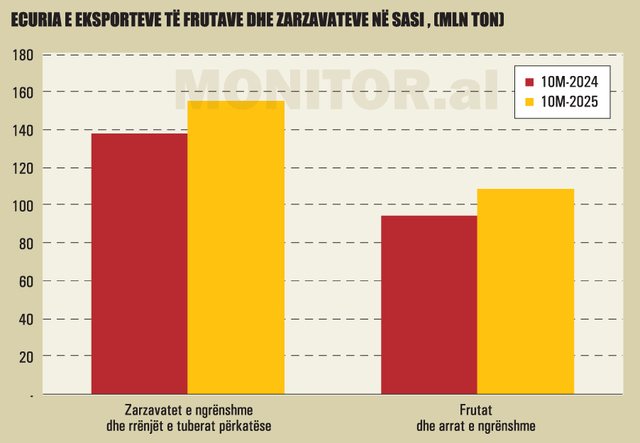



Fresh produce exports grew at double-digit rates in both value and volume during the first eight months of 2025, but on the other hand, the sector further deepened the decline by 2.6% in the first six months. Farmers and exporters claim that agriculture is being consolidated into large farms specialized for export, while small traditional farming farms are going bankrupt. Reasons why food imports and exports are increasing simultaneously. Membership costs that are putting agriculture against the wall. Serbia is the main partner in exports, while EU markets are showing fluctuations.
The increase in agricultural exports, both in quantity and value, and on the other hand, the decline in production, is showing that the sector is heading towards consolidation. Small and medium-sized farms in rural areas of the country are going bankrupt due to the shrinking and aging population, while large livestock farms and greenhouses in areas with intensive agriculture such as Fier, Lushnja, etc. are growing and expanding, with the aim of export.
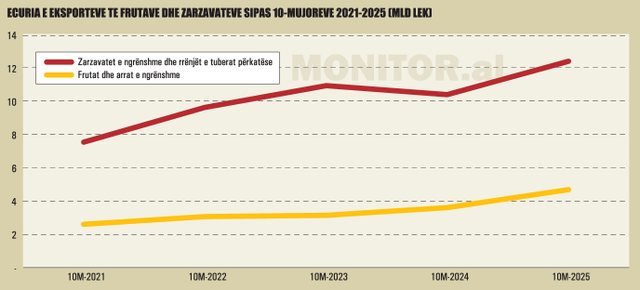
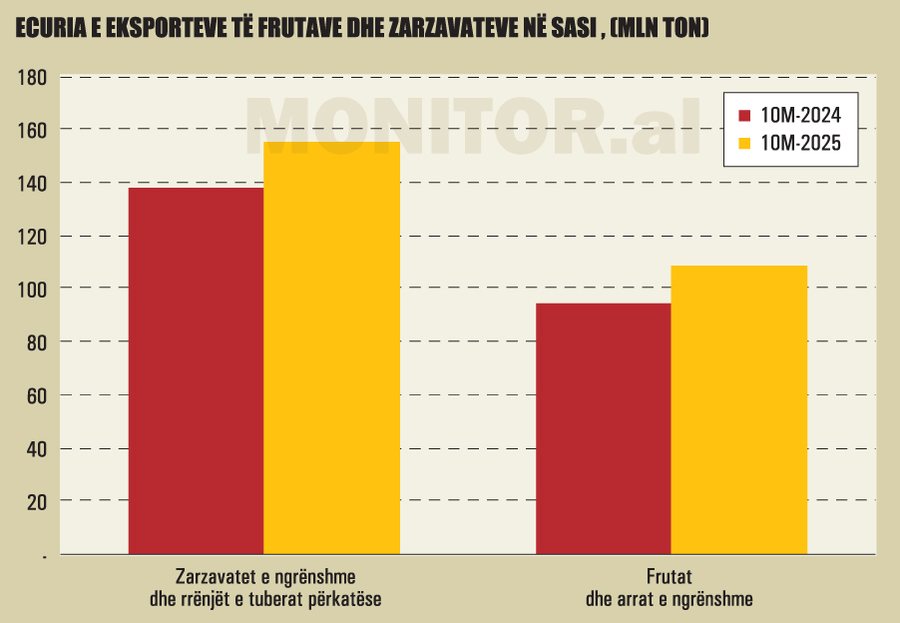
Data for the period 2021–2025 show a steady and strong growth in vegetable and fruit exports, with the total expanding by around 70%. Their value reached over 17.1 billion lek in the first 10 months of 2025, up from 10.1 billion lek in the same period of 2021.
Compared to the first 10 months of 2024, fruit and vegetable exports increased by 22% in value.
Mariglen Ziu, a farmer who operates in the field production sector in the Samatica area of Berat, says that production is not expanding, but is being maneuvered with some crops that are believed to increase value. For example, in recent years, the export of melons and cabbages has increased significantly.
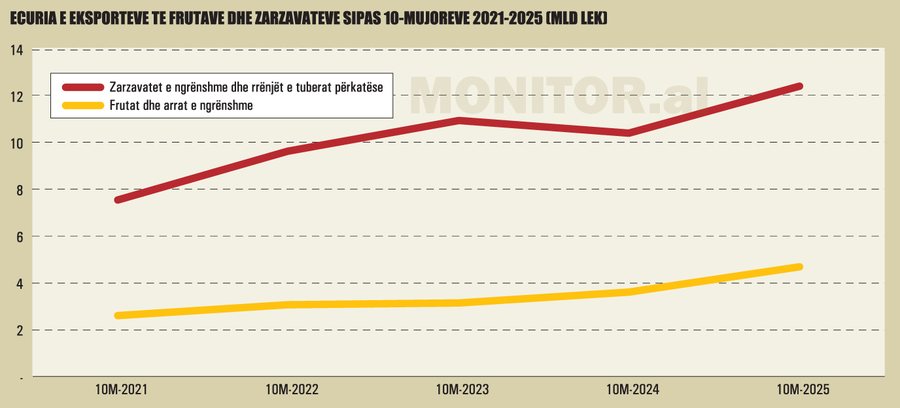
Fruits and vegetables have increased significantly in value and quantity of exports in the last two years. Their cultivation is usually done on specialized farms on many hectares, both in greenhouses and in the field for export. Farmer Ziu says that the base of people engaged in agriculture is not expanding, on the contrary, their number is shrinking every day, but some large farms are expanding their areas, he said.
On the other hand, the agricultural sector deepened the contraction this year with -2.6% in the first 6 months. Agriculture is in its fifth year of decline, in terms of production volume. Ruzhdi Koni, an experienced exporter of agricultural products, said that the increases in sales abroad are reflecting the evolution of the agricultural export segment, which has become increasingly specialized and more connected to European markets.
This, according to him, has enabled the increase in the value and quantity of exports, despite the general challenges the sector is going through. Data from INSTAT showed that employment in the agricultural sector marked an annual decline of 10% in the third quarter of this year, also reflecting the strong contraction of the rural population.
At the same time, as agricultural exports increase, imports are also increasing. In the first 10 months of this year, the food group increased by 2% in quantity and 3.4% in value. In the absence of extensive production on small farms for the market and for self-consumption, the market is being supplied from abroad.
Amid problems with high fragmentation, lack of subsidies, producers face high post-harvest losses. More than 25% of production in some crops ends up as post-harvest waste, due to low prices or lack of storage capacity.
Why are exports increasing?
Mr. Koni says that the increase in agricultural exports is related to several factors that have operated after the pandemic. First, international prices of fruits and vegetables have increased significantly after 2022, due to inflation in the food group. At the same time, climate change has damaged important producers such as Italy, Spain and Greece. Albania has benefited from this situation, being able to offer competitive products at times when traditional suppliers had reduced volumes. This has caused the value of exports to increase and the real volume of production may have been more moderate.
In many cases, Albanian exporters have sold similar quantities to the previous year, but at significantly higher prices, generating a spread increase throughout the supply chain.
At the same time, Albania has consolidated a core of large producers, capable of competing in international markets. Mr. Ziu said that investments in greenhouses in the areas of Lushnja, Divjaka, Fier and Kruja, together with the spread of modern irrigation technologies, controlled fertilization and year-round production cycles, have significantly increased the volume of export-oriented production. These producers now operate under stable contracts with collection companies and export traders. A major role is also played by the increase in processing and storage capacities in refrigerated warehouses, selection lines, packaging and certifications such as GlobalG.AP.
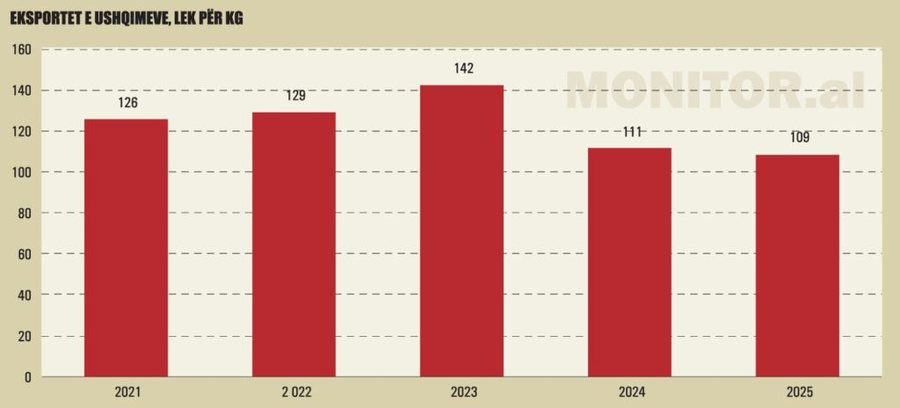
Data shows that export prices are declining after the post-pandemic increase. From 2021 to 2023, exports of the food group in Lek increased significantly, from around 35.9 billion Lek in 2021 to over 46.3 billion Lek in 2023.
This period is also accompanied by an increase in the quantity exported, a fact that indicates positive performance of the sector, influenced both by external demand and by higher prices of food products in international markets.
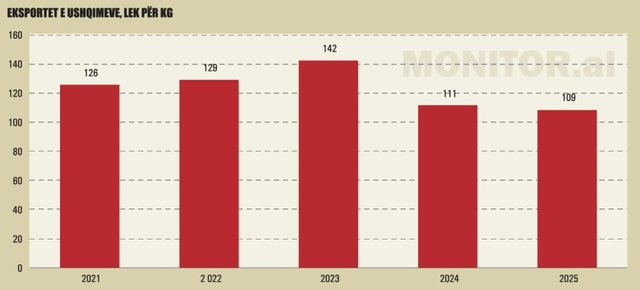
In 2024, although the amount of exports increases again, there was a significant decrease in the average price per kilogram, which drops from 142.3 lek/kg in 2023 to only 111.3 lek/kg in 2024.
This is because prices in international markets fell and the export of melons, which weigh more and cost less, also increased. In 2025, the value of food exports fell further, reaching 108.7 lek/kg in the first 10 months of 2025, the lowest level in five years. This indicates that the increase in export value this year is not a result of higher prices, but from the expansion of export volume.
However, this positive development in the export segment exists in parallel with a noticeable contraction of agriculture on a national scale.
The main reason is the massive emigration of the rural workforce, which has left behind numerous uncultivated plots and increased production costs for farmers who continue the activity.
Many small farms are unable to afford the ever-increasing costs of fertilizers, seeds, pesticides and agricultural oil, resulting in land abandonment year after year. The decline in investment in small and medium-sized farms in agriculture has reduced total production, causing the sector as a whole to make a lower contribution to the economy.
Food imports also increase
During the period January-October 2025, food imports increased in both value and quantity. Official data show that 135 billion lek of food (about 1.4 billion euros) were imported, or 28% more than in the same period in 2021.
The steady growth in imports is coming at a time when the country's population is shrinking, especially among the younger generations who are also the biggest consumers.
A good part of Albanian agricultural production is no longer competitive in the domestic market, where prices are often lower than those in foreign markets. This has led the best producers to shift their focus towards exports, leaving the domestic consumer increasingly dependent on imports, especially for seasonal products.
Farmer Ziu says that exports are increasing not because domestic production is sufficient, but because the highest quality and highest yielding part of production is channeled towards the foreign market, as he is doing with his own products. Also, imports in the agricultural sector are being driven by tourist flows, which instead of boosting domestic production have increased imports, not only in agriculture, but throughout the tourism chain.
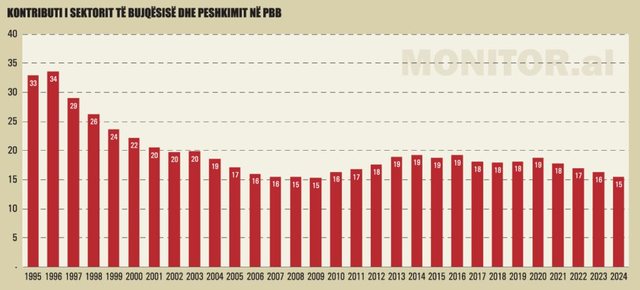
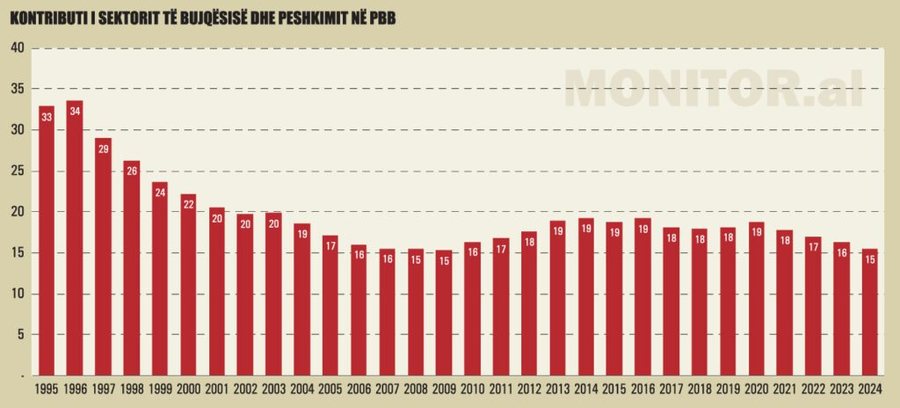
Experts claim that agriculture has entered a strong restructuring process, where on the one hand, a modernized export segment is growing at high rates and on the other hand, traditional agriculture is shrinking rapidly. In total, agriculture remains among the sectors with the largest decline in contribution to GDP with 15.6% in 2024 from 19.2% in 2014, highlighting significant structural difficulties.
Food imports have increased both in quantity and monetary value (lek), while the average price per kilogram has fluctuated significantly during the period 2021–2025.
The amount of imported food started at around 904.7 million kg in 2021 in the 10-month period and fell slightly in 2022, but then the growth becomes stable year after year, following the increase in the number of tourists and the decline in domestic production.
In the first 10 months of 2024, the level of 1.078 billion kg is reached, while for 2025, there is another strong increase, to 1.1 billion kg, marking the highest level in the five-year period. In monetary value, imports have followed the same upward trend, but with more pronounced fluctuations. After rising to 138 billion lek in 2022, they fall to 121.6 billion lek in 2023, to increase again to 130.6 billion lek in 2024 and are projected to 135.1 billion lek for 2025.
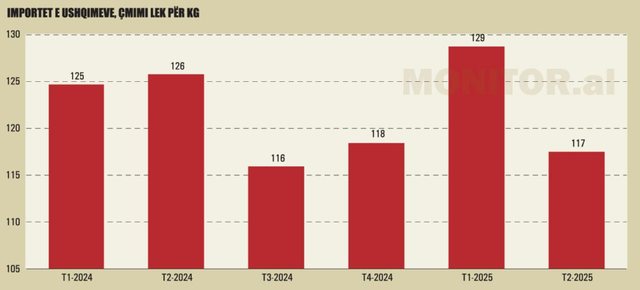
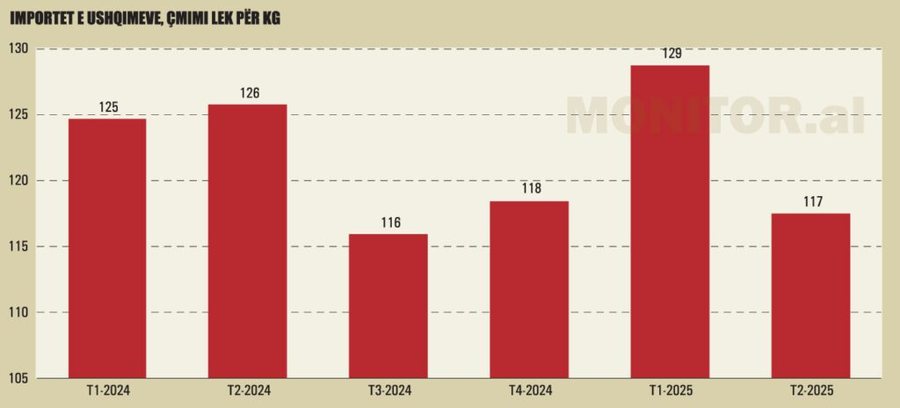
The average price per kilogram of imported food has fluctuated due to the crises of recent years. From 116.6 lekë/kg in 2021, it increased sharply to 157.6 lekë/kg in 2022, as a result of international food inflation and rising transportation costs.
Then, the price marks a correction in 2023 and 2024, falling to 132.3 and 121.1 lek/kg respectively, which suggests stabilization of international markets.
In the 10-month period of 2025, there was a further decrease of 120 lek/kg, but still much lower compared to the peak of 2022, reflecting stabilization after the crisis.
The second production season failed.
The second planting season, which begins in December-January in the Myzeqe area, is resulting in losses for producers, as a result of the damage caused by the November floods and low product prices in export markets.
Farmer Ziu said that Albania is competitive for the second production season, due to its geographical and climate advantages, exporting fresh vegetables at high prices to regional markets and beyond, which has already closed the harvest season.
But this year, the situation has changed to the detriment of farmers. Export crops in the fields – leeks, cabbage, carrots, etc., were completely damaged by the November floods. “My losses this season are 2.5 million lekë (new) after about 30 dunams of cabbage planted in the field were destroyed,” said Mariglen Ziu.
On the other hand, the prices of secondary products in export markets are very low because the warm weather has also favored production in neighboring countries. This has led to sufficient production in the markets and very low prices.
In the first 10 months of 2025, a kilogram of fruits and vegetables was sold by exporters for 64.9 lek, according to INSTAT data, but in November and December, prices are even lower. In 2023, the price per kilogram was 76 lek, reaching a historical high, and has been decreasing since then.
Albanian farmers are completely exposed to market prices, raw material costs, and climate crises, as they do not receive financial support and are not included in the insurance system.
In 2026, 5.2 billion lek will be distributed to farmers in the form of subsidies and grants according to the Ministry of Agriculture. Albania continues to offer much less support for agriculture than Europe and the region, while we are unable to benefit from EU funds, due to corruption found in their use.
Vegetable exports, main partner Serbia, strong growth with Poland
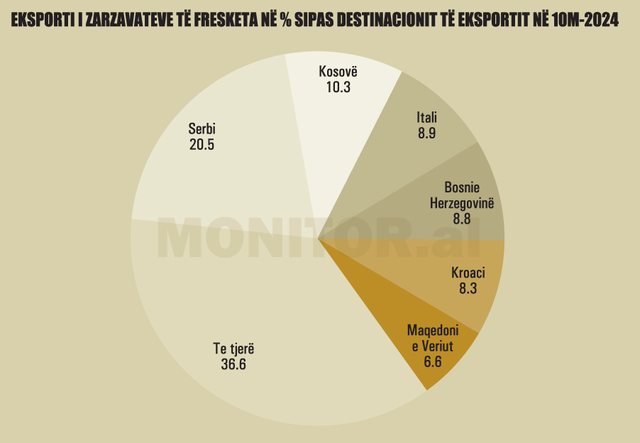
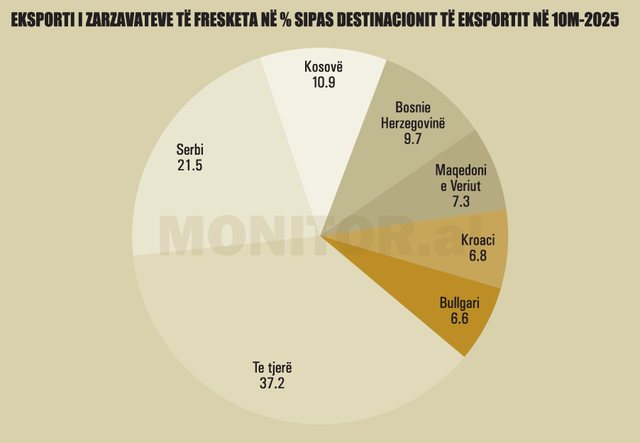
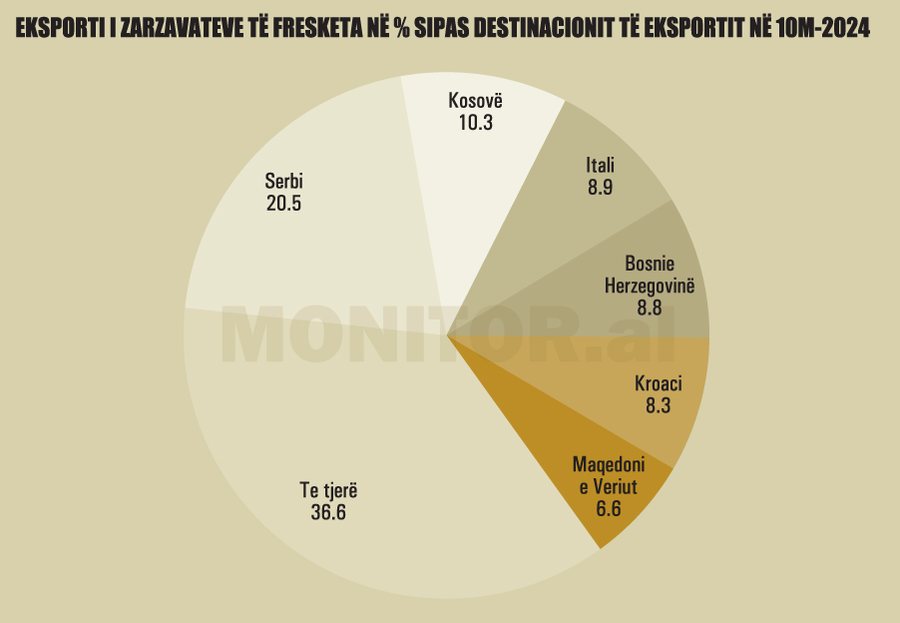
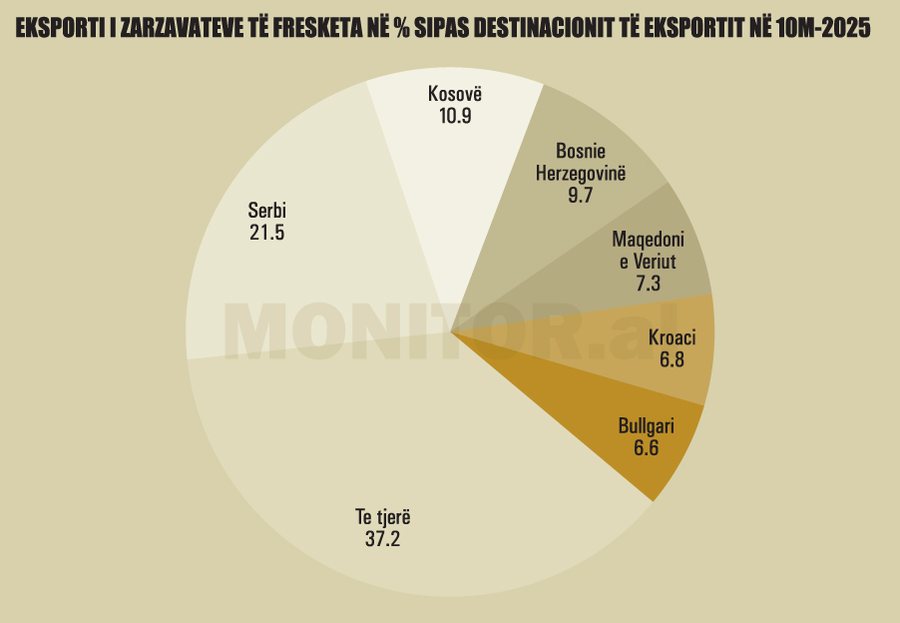
Exports of vegetables (excluding fruits) reached 12.4 billion lek, a 20% increase in value. The largest export market this year was Serbia. 2.6 billion lek of vegetables were exported to this country, with an annual increase of 25%, accounting for 21% of total vegetable and green sales from January to October 2025.
The data clearly shows that the structure of Albanian vegetable exports remains mainly concentrated in the regional market, reflecting a strong dependence on neighboring countries and the Western Balkans.
A similar trend is observed with Kosovo, Bosnia and Herzegovina and North Macedonia, where exports have increased at double-digit rates, confirming that the region remains the main axis of Albania's trade exchanges.
Croatia and Bulgaria also occupy an important position on the export map, although the dynamics are different. While exports to Bulgaria have increased significantly by 26%, Croatia shows a slight decrease, signaling fluctuations in demand or changes in the structure of exported products. Overall, the Balkans continue to dominate, not only due to geographical proximity, but also due to lower logistics costs and traditional trade ties.
Mr. Koni said that there was a strong growth in spring, of cabbage and melon in new EU markets, especially in Poland and some Nordic countries. Exports of fresh vegetables to European Union markets appear more fragmented. Italy, historically one of Albania's main partners, marks a strong decline in exports, with over 38% less compared to a year ago, giving a worrying signal of weakening demand or shifting trade flows.
A significant decline is also observed in France, Switzerland and Norway, which indicates that Albanian exports to some of the developed European markets are facing difficulties.
However, there are also positive exceptions within the EU. Exports to Germany increased by 97%, to Poland by 106%; to Romania by 66%, and to Sweden by 145%, with strong growth, due to their low base, but also to the fact that there is room for expansion in these markets and that some sectors are managing to penetrate better.
Huge losses after harvest
Unplanned production and supply chain problems mean that a large portion of agricultural produce ends up as waste. Farmers in the Lushnja area claimed that often, nearly half of a crop is thrown back into the ground.
Agricultural statistics have low reliability according to Eurostat and the government does not guide farmers on production based on domestic consumption plans.
The country does not yet have a national monitoring system that regularly measures all crops. Sectoral reports show that crop losses range from 10% to over 50% for fruits. Losses include damage at harvest, lack of refrigeration, damage during transport and damage at the market.
It is noted that after each production cycle, many farmers are forced to throw away significant amounts of fruit, not because they are unfit for consumption, but because they do not have the conditions to store them or get them to market in time, or the prices are too low.
The lack of proper technology at the harvest stage is damaging many fruits and vegetables through careless handling. In many areas, the produce remains in the sun for hours before leaving the field, accelerating decay.
Further, the storage phase presents the greatest challenges. Albania has limited refrigeration capacity, much of which is used inefficiently.
Studies show that the lack of immediate post-harvest cooling is a critical factor that significantly increases losses, especially in apples and citrus fruits. Inadequate packaging, insufficient warehouse hygiene, and transport vehicles without temperature control further increase the damage.
During transportation, losses are exacerbated by worn-out roads and the use of non-refrigerated vehicles, which leads to mechanical damage and a decline in quality.
In the market, especially in open markets, products are exposed to high temperatures, sun, humidity or unsafe storage conditions, causing fruits and vegetables to quickly lose commercial value or become unusable.
A previous CIHEAM study, the only one with direct measurements in Korça markets, found that losses in the trading chain for fruits such as apples, peaches or grapes ranged from 11% to over 17%, not counting losses in the field and transportation, which would increase the real figure even further.
Post-harvest losses in Albania are a consequence of the fragmented structure of agriculture, where small and individual farms do not have the capacity to invest in warehouses, selection lines or storage technologies. The lack of functional cooperatives, access to markets and agricultural advisory services makes it difficult to standardize modern practices.
According to official data from Eurostat and the European Commission, 60 million tons of food is wasted in the EU every year, 130 kg of food wasted per capita per year.
This includes food lost and wasted throughout the food chain from farm production, processing, distribution, shops, restaurants and consumers' homes. Losses in the EU are lower than in Albania as supply chains and the circular economy function well.
Agricultural costs from EU membership
Albania aims to become an EU member state by 2030, but to adapt to European Union (EU) standards as part of the accession process, agriculture must transition from a largely informal and low-productivity sector to a formalized, certified and sustainable system, in line with the EU's Common Agricultural Policy (CAP).
For an average vegetable or fruit farm of 10–15 ha, the first phase comes with the cost of certification for the GlobalG.AP criterion, which is practically a basic requirement for many European importers. The initial cost for preparation, documentation, and auditing usually ranges from 1,500 to 3,000 euros.
The certification must then be renewed annually, at an annual cost ranging from 800 to 1,500 euros, depending on the size of the farm and the number of plots. Ruzhdi Koni, who has been exporting agricultural products for years, says that the costs of adaptation for the entire Albanian agricultural chain are too high for the capacities of Albanian farms.
After certification, comes formalization and administration. Activity registration, accounting, tax declarations, and basic administrative services cost an average of 600 – 1,200 euros per year. These are costs that were previously absent for the informal farmer, but become necessary for export.
Another important item is traceability and technical documentation. EU standards require records of production, pesticide use, agronomic advice and in some cases, the use of simple digital systems with additional costs of around 500 – 1,000 euros per year, mainly for advisory services and documentation management.
The costs increase significantly when we get into laboratory testing. Mr. Koni says that for every export shipment, tests are required for pesticide residues and other parameters. A full analysis for a fresh product typically costs 150-300 euros per shipment. If an exporter ships 20-30 shipments per year, the tests alone can reach 3,000-7,000 euros per year.
At the market level, there are also contractual costs and commercial risk. To fulfill contracts with European importers, the exporter must hold reserves, secure alternative supplies, and bear losses from the rejection of a shipment.
Sector experts estimate that the initial cost of entering the EU export market (certification + basic investments) can reach 25,000 - 50,000 euros, while the annual cost of maintaining standards usually ranges from 6,000 to 12,000 euros, not including trade risks.
The EU has very strict rules for food circulating in the common market. Albania must fully implement the HACCP, ISO 22000 and GlobalG.AP standards.
Membership makes us uncompetitive
In the perspective of EU membership, Albanian agricultural exports will face even greater competitive pressure. Full market opening means more export opportunities, more competition from consolidated European producers.
Experts say that without serious investments in standards, organization and processing, there is a risk that Albanian agriculture will remain mainly a supplier of peripheral markets or will export only low-value products. If it manages to move from casual exports to certified exports, Albanian agriculture could become one of the sectors most positively affected by European integration.
Albanian agricultural exports to the European Union still remain limited in volume and concentrated in a few products, despite the potential that our country has due to its climate, geographical position and relatively low production costs.
Currently, Albania exports mainly fresh fruits and vegetables, medicinal and aromatic plants, olive oil and, to a lesser extent, processed products. However, its presence in the European market is still fragile and unstable, as a large part of exports is carried out seasonally and without long-term contracts.
The main obstacle to increasing exports remains meeting EU food safety standards and technical requirements. The European market requires full product traceability, accurate documentation on pesticide use, internationally recognized certifications, and regular laboratory controls.
In many cases, Albanian farmers produce good quality but fail to document it according to EU rules, making the product unacceptable to European importers. This creates a gap between the real production potential and the ability to transform it into sustainable exports.
However, in some sub-sectors, Albania has managed to establish a more sustainable position. Medicinal and aromatic plants are a positive example, as the country has benefited from tradition, biodiversity and earlier integration into structured export chains.
Even in this case, the added value remains limited, as exports are mainly realized in the form of raw materials and not as processed products with an Albanian brand./Monitor.al/