



The expansion of employment in recent years, especially after the pandemic, is being led by retirees. The emigration of young people and the increase in demand for work have led more and more retirees to engage in the labor market, also to compensate for the very low income from retirement.
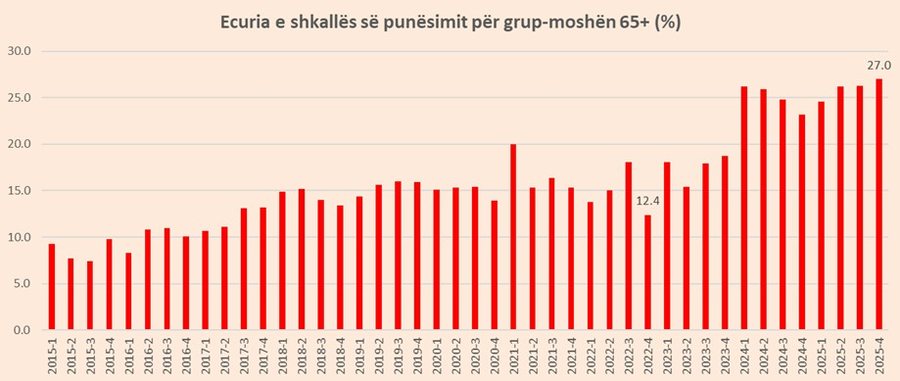
The latest data from INSTAT showed that the labor force participation rate for the over-65 age group was 27% in the last quarter of 2025, up from 23% in the same quarter of 2024. Almost the entire percentage of retirees participating in the labor force is employed. The employment rate for the over-65 age group also stood at 27% in the last quarter of 2025.
In 2015, the average employment rate of retirees was 8.6%, the figures for 2025 show a three-fold increase. This increase reflects not only the economic need to increase incomes in old age, but also the pressure that youth emigration is exerting on the labor market, forcing businesses to rely on older workers.
Analysis by educational level shows that the main weight in this phenomenon is held by pensioners with 8 and 9 years of education. This category has recorded the most aggressive growth, peaking in the first quarter of 2025 with an employment rate of 29.7%. This fact shows that a large part of pensioners who remain active in the market are engaged in sectors that require manual labor or low qualifications, such as agriculture or support services, where the shortage of young labor is most acute.
On the other hand, elderly people with secondary education have also recorded progressive progress, increasing from the minimum levels of 4-5% observed in 2014-2015, to a record of 26.6% in the last reported period.
The situation is different for the category with higher education. Although there is a slight increase compared to previous years, the employment rate for intellectuals over 65 years old remains the lowest among the groups, fluctuating around 14.9%. This gap shows that while the market urgently needs simple workers, the integration of older people into highly qualified professions remains limited or dictated by the natural process of exiting the administrative system.
Data shows that the retirement age is becoming increasingly formal, with old age becoming a main pillar of human capital./Monitor.al/