

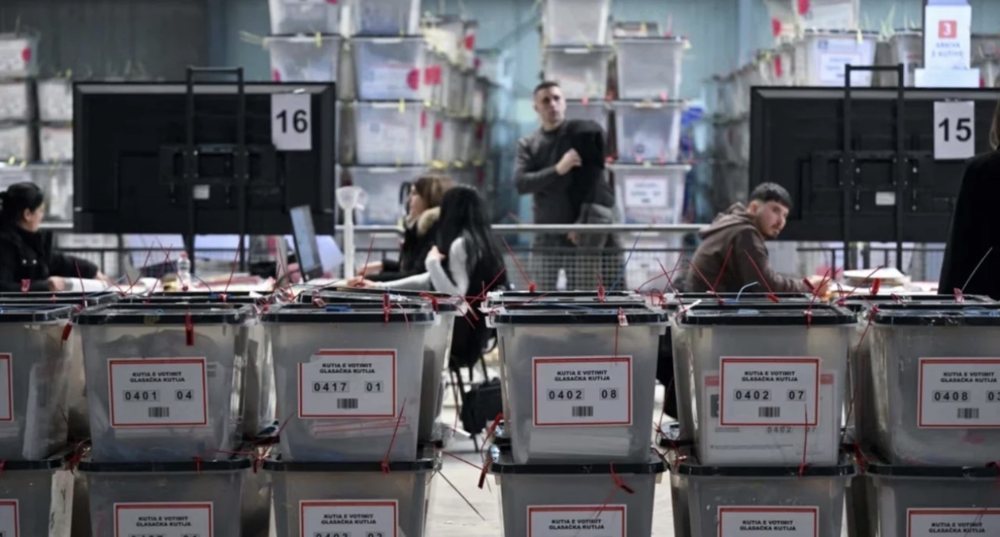
With 11 votes, members of the Central Election Commission (CEC) in Kosovo certified the results of the early parliamentary elections of December 28.
"With all the reservations we had about the Serbian List, we have them and will continue to have them," said Sami Kurteshi from the Vetëvendosje Movement, after voting for the certification of the election results.
Kurteshi and the other LVV member in the CEC, Alban Krasniqi, have in the past voted against the Serbian List in the CEC several times, either for the participation of this party – which has the support of Belgrade – in the elections, or for the certification of this entity’s results. However, the decisions were later overturned by the Electoral Panel for Annexes and Submissions and in some cases later by the Supreme Court.
The election results were certified after all deadlines for complaints by parties and candidates regarding the final results announced by the CEC days earlier had expired.
Dissatisfied parties had the opportunity to appeal to the Electoral Complaints and Appeals Panel and then to the Supreme Court.
The certification process comes after a full recount of regular votes, which was decided after discrepancies were found in the votes of the candidates for deputies. Party votes were not affected.
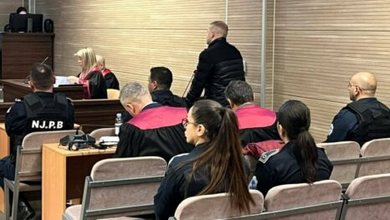
Dozens of people have been taken into custody, hundreds more have been interviewed on suspicion of vote manipulation, and investigative and judicial processes are expected to continue.
The State Prosecutor's Office has warned that the candidates for MPs themselves may also be the subject of investigations.
Who won how many votes?
According to the final results announced by the CEC on January 31, the Vetëvendosje Movement won 51.10 percent of the vote, securing 57 seats in the Kosovo Assembly. The Democratic Party of Kosovo received 20.19 percent of the vote, or 22 seats, the Democratic League of Kosovo 13.24 percent, or 15 seats, and the Alliance for the Future of Kosovo 5.50 percent, or six seats.
Of the seats reserved for the Serb minority, nine seats were won by the Serbian List, the largest Serb party in Kosovo, and one seat by the Party for Freedom, Justice and Survival.
What happens after the CEC certifies the result?
According to the Law on General Elections, after the certification of the election results, the next step comes, that of holding the constitutive session.
This session must be held within 30 days and must be called by the President of Kosovo, Vjosa Osmani. However, if she does not call it, according to the Rules of Procedure of the Assembly, the Assembly convenes on its own on the 30th day.
The regulation stipulates that there must be preparations for the constitutive session and this responsibility falls on the speaker of the previous legislature, in this case it is the responsibility of Dimal Basha.
He must, no later than five days before the constitutive session, hold a joint meeting with the heads of parliamentary political entities to prepare the agenda and assign seats to the deputies in the new Assembly.
The regulation stipulates that the constitutive session has four agenda items: the formation of the Temporary Committee for the Verification of Quorum and Mandates, the swearing-in of the deputies, and the election of the Speaker of the Assembly and the Deputy Speakers.
Regarding the constitutive session, last year there was a lot of uncertainty and the Constitutional Court, through several judgments, determined that this session must be concluded within 30 days, and is considered concluded only with the election of the president and five vice-presidents - three from the main Albanian parties and two from the non-majority communities, one Serb and one from the Serb communities.
Both the president and the vice presidents require 61 votes from the 120-member Assembly.
Based on the verdicts, a person can only be nominated up to three times for the position of president and vice presidents.
However, in the case of the Serbian vice president, in a judgment published days ago, the Constitutional Court found that violations were committed when Nenad Rashiqi was elected from the Party for Freedom, Justice and Survival, through a lottery in the previous legislature.
He was nominated in this way after the Serbian List nominees failed to secure 61 votes.
The Constitutional Court ruled that the majority of deputies from the Serb community, which in this legislature also includes the nine deputies from the Serbian List, have the right to propose a deputy speaker. The decision was criticized by Albin Kurti's Vetëvendosje Movement, and it remains unclear how they will act on the issue of the Serb deputy speaker during the new legislature.
Once the constitutional issue is concluded, the way is opened for the formation of the new Government of Kosovo. The President must mandate someone from the winning party, in this case the LVV, as Prime Minister.
The mandate holder then has 15 days to present the new composition of the executive to the Assembly and seek the support of at least 61 deputies.
Unlike last time, Kurti is expected to have no difficulty making the numbers for the Government, as his party alone has won 57 seats in the Assembly.
The president's issue
If MPs want to avoid another election, then they will need to act quickly to constitute the Assembly and form the Government, in order to meet the March 4 deadline - the last date for electing the country's new president.
President Osmani has a mandate until April 4, but the new president cannot be elected later than 30 days before this date.
Osmani herself has expressed her desire to serve another five-year term as head of state. However, it remains unclear whether she will be able to secure the necessary support.
President Osmani has been criticized several times during her mandate for siding with the Vetëvendosje Movement.
In an interview with Radio Free Europe at the end of December, she said that if she does not win another mandate, she will return to political engagement, without specifying which party.
The leader of the LVV, Albin Kurti, told the media a few days ago that he had spoken with Osmani about the issue of the president, but that, according to him, there should be a new relationship with the opposition parties on the issue of the new head of state.
A few hours before the certification of the result, Osmani met with the leader of the Democratic League of Kosovo, Lumir Abdixhiku, the party to which Osmani previously belonged and whose deputies had remained in the hall, enabling the quorum for Osmani's election five years ago.
It is unclear whether the issue of Osman's mandate was discussed at this meeting, but Abdixhiku said that he discussed "recent political and international developments of importance for Kosovo" with the head of state.
The leader of the Alliance for the Future of Kosovo, Ramush Haradinaj, also held a separate meeting with Osmani, who said he discussed with the president "political developments in the country and the region."
At the invitation of the President of the Republic, Vjosa Osmani, I held a discussion on the Peace Board and political developments in the country and the region.
Under the Constitution, the new president is elected through a secret ballot, and anyone who wants to run must collect the signatures of at least 30 deputies.
The head of state is elected with two-thirds of the votes in the first two rounds of voting, but if there are not enough votes in these two rounds, then in the third round the candidate who receives the majority of the votes of the deputies is elected.
If the presidential election fails, new elections are automatically announced, which must be held within 45 days./REL