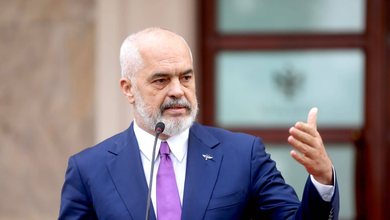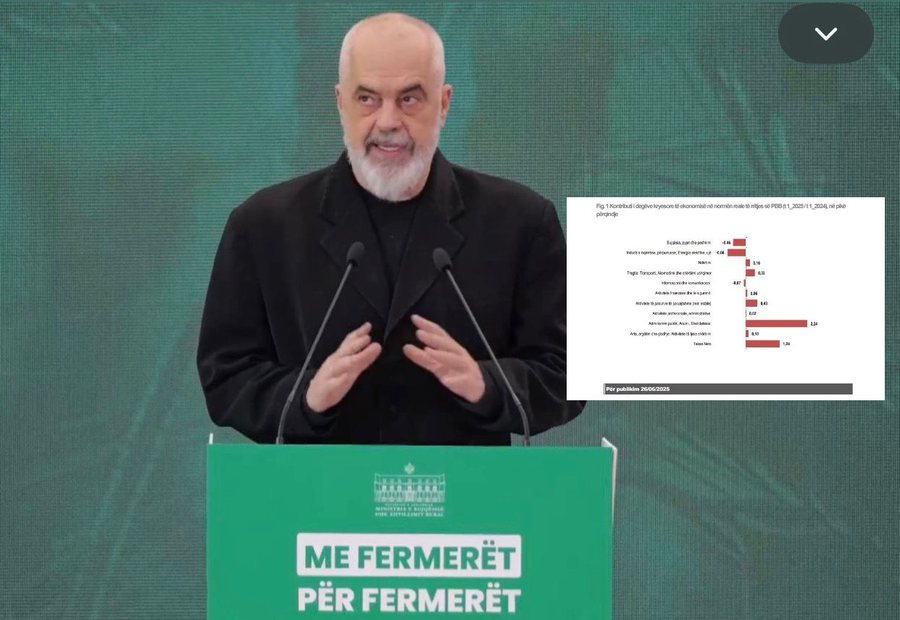
Prime Minister Edi Rama appeared today at a meeting with farmers in Elbasan, where he spoke in superlatives about the government's achievements and statistics in agriculture, without reading what INSTAT says. In his speech, Rama said that agricultural exports have increased and are higher than last year's value.
"The three mandates when exports have begun to grow, reaching a value that this year in the first 9 months alone is higher than the value of last year, approaching half a billion euros in exports," said Rama.
But the prime minister's words contradict INSTAT figures, which show that agriculture is in decline and has been in crisis for years. According to INSTAT, even in the second quarter (April, May, June 2025), agriculture contributed negatively to the economy, as it fell by 0.46%.
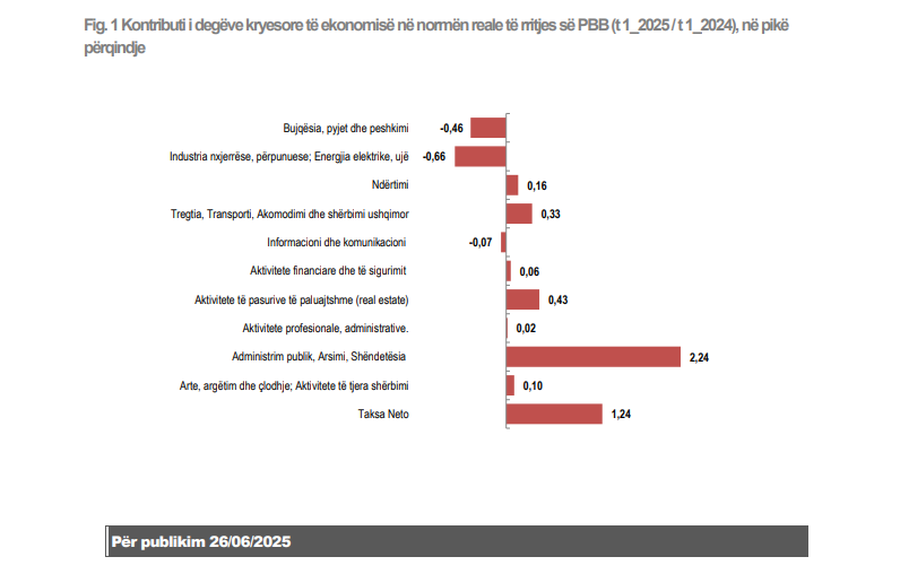
If agriculture, as one of the most important productive sectors of the Albanian economy, continues to contribute negatively to the economy, then what value do the Prime Minister's statistics have besides propaganda?
The agricultural sector has been hit hard in recent years due to mass emigration, bad fiscal policies, and government corruption that deprived Albanian farmers of European Union grants.
Rama seems to be compensating for the lack of IPARD funds with promises from the budget scheme, according to which all payments will be closed within this year, although there are still a few days left until the 2025 deadline.
"Only in the national scheme do we go with a budget that is double the amount of the year that is ending. As for the direct scheme, all payments will be closed within this year 100%," said Rama.
We recall that Albania has been without financial support from IPARD funds for more than two years, the most important program that the European Union offers for rural development in candidate countries.
In August 2023, the European Commission suspended funding due to misuse and irregularities found by the European Anti-Fraud Office, following investigations that revealed cases of corruption, favoritism and political interference in the IPARD II scheme.