


By Sokol Sadushi
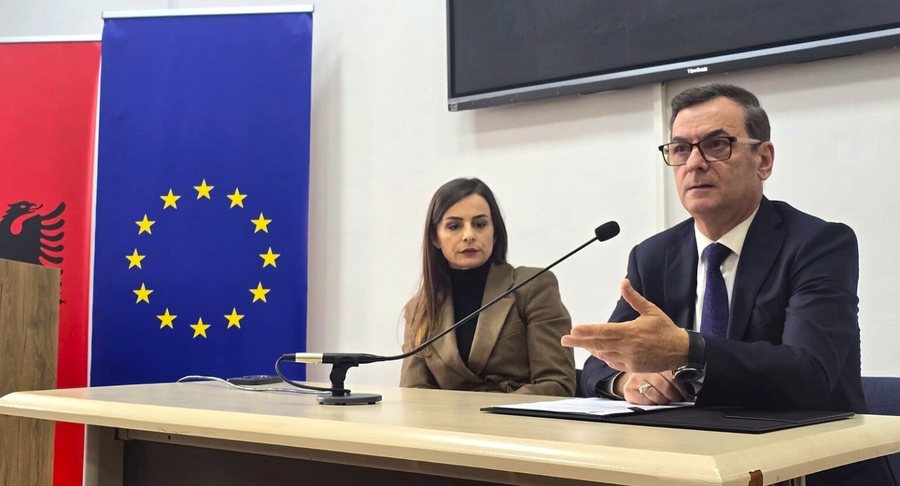
During a meeting with students of the Faculty of Law, the President of the Supreme Court of Albania, Sokol Sadushi, focused on the issue of pre-trial detention, emphasizing that this measure should not become common practice, but should only be used when it is truly necessary and justified by concrete facts.
He stressed that pre-trial detention is one of the most sensitive issues in a state governed by the rule of law, as it directly affects personal freedom and the quality of judicial control. According to him, excessive use of this measure risks weakening the presumption of innocence and lowering the standard of judicial reasoning.
Referring also to the jurisprudence of the European Court of Human Rights, Sadushi underlined that detention decisions should be individualized, proportionate and accompanied by a realistic consideration of alternative measures. The main message was clear: personal freedom should remain the rule, while detention should remain the exception.
The full speech of Mr. Sadushi:
Introduction:
Pre-trial detention is one of the most sensitive issues in a state governed by the rule of law, as it simultaneously affects daily judicial practice, penal policy, public perception of crime and the relationship with European standards. The way in which pre-trial detention is used serves as a direct indicator of the quality of judicial control over personal freedom, which is verified by the level of individualization of the assessment, the provability of the alleged risk and the real implementation of alternatives.
In Albania, this topic takes on special weight not only because of the social sensitivity towards crime, but also because the standard of security measures is a daily “test” of the functioning of the rule of law. When pre-trial detention increases and becomes a common practice, we do not have just a statistical issue, but a signal that the guarantees of personal freedom and the quality of judicial reasoning are weakening. The debate on pre-trial detention is not a debate about tolerance towards crime; it is a debate about rigor towards the standard. The emphasis, therefore, is not on the rhetoric “for” or “against” severity, but on the requirement that the restriction of freedom be based on concrete circumstances and be convincingly justified, in function of the purpose of the measure and possible alternatives.
In this sense, this analysis is based on three pillars: the institutional role, the international standard and the academic obligation. It aims to be a principled reflection on the constitutional and convention standard of security measures, in the light of the jurisprudence of the ECHR and the obligations arising from Albania’s membership in the Council of Europe, as well as from the process of integration into the European Union. The issues are raised on a professional and civic level: not to “judge” the system, nor to comment or prejudge specific issues, but to identify the factors that fuel the high level of pre-trial detention, to propose solutions and to remind that freedom is the rule, while pre-trial detention is the exception.
1. Security measures and the culture of detention
Personal security measures guarantee the criminal process: the presence of the suspect, the integrity of the evidence and the prevention of concrete risks. They are not a preliminary punishment and cannot replace the efficiency of the investigation by isolation. In this sense, detention is the most severe restriction of freedom and can only be imposed when it is truly necessary, individualized and proportionate, and when alternative measures are not sufficient.
When detention is treated as the “first choice”, due to public pressure, procedural convenience or standardization of reasoning, the fundamental balance between the public interest and individual rights is put at risk. The debate on security measures is therefore not simply technical. At its core, it is a debate about the quality of reasoning and the professional courage to decide according to the standard, not according to expectations.
2. Why does this concern require immediate attention?
International reports on Albania (Council of Europe, European Union and UN mechanisms) have signaled a structural problem: the level of pre-trial detention is high and often prolonged, causing pre-trial detainees to constitute over half of the prison population.
According to published data, in December 2025, it was reported that there were 4503 people in Albanian prisons, of whom 2569, or 57%, were detained awaiting trial. When over half of the prison population is still untried, we risk turning the exception into the rule. This percentage is an alarming indicator: the measure “prison arrest” risks becoming normal.
In practice, the high level of pre-trial detention is fueled by a vicious circle because:
- the prosecution tends to request the most severe measure as an immediate "guarantee";
- the court, under the pressure of public criticism or reputational risk, may be tempted towards the solution that is “safer” in public perception;
- alternative measures are dealt with formally, with a standard sentence;
- processes take longer; detention is extended and arrest begins to be treated as the first choice, not as an exception.
This culture produces two serious consequences: first, it weakens the presumption of innocence in public perception; second, it increases the risk of conventional violations, accompanied by state punishments and reduced trust in justice.
3. Where does the fundamental problem lie?
The professional debate has identified the “weak point”. Problems arise from the initial phase, when risks are often raised in an abstract manner (“risk of flight”, “risk of evidence destruction”), without being linked to concrete and individualized circumstances. This is fueled by “external pressure” and “fear” of consequences, pushing decision-making towards the logic of “better inside, lest something happen…”. The Convention does not recognize this approach as a criterion. It requires verifiable, individualized and fact-based reasoning.
Another weak point is the formal treatment of alternatives. Alternatives are not just a formal reference; they are part of the test of necessity and proportionality. Without a real examination of them, detention loses its exceptional character.
The third problem is “inertia”. With the passage of time, the reasoning cannot remain unchanged; circumstances develop, the proceedings move from one stage to another and, consequently, the burden of reasoning increases. Therefore, any extension of pre-trial detention must be based on actual and verifiable elements, not on the repetition of the same formulas. If the decision is repeated with the same phrases, pre-trial detention returns to a routine state, not a justified measure.
4. Constitutional and Conventional Obligation: What Does the ECHR Demand from Albania?
The jurisprudence of the Strasbourg Court (ECHR) treats pre-trial detention as an exceptional measure. Two important decisions (Hysa v. Albania and Gëllçi v. Albania) set the standard with clarity: the problem is not the lack of rules, but the practical application of individualization, proportionality and real consideration of alternative measures.
First, the ECtHR sets the cornerstone of any decision on security measures. The reasonableness of detention “cannot be assessed in the abstract… [but] must be assessed on the facts of each case and according to its specific features…” (Hysa v. Albania, §66). This means that it is not enough to allege “risk of absconding” or “risk of evidence being tampered with”. The decision must clearly explain: What facts establish the risk? Why is the risk real in that case? Why is it not neutralised by less restrictive measures?
Secondly, the Court makes it clear that “reasonable suspicion” is only the gateway to detention and not a permanent justification. In the case of “Gëlçi v. Albania” it is expressly stated: “... the continuation of a reasonable suspicion is a condition sine qua non for the validity of detention in prison, but it is no longer sufficient after a certain period of time…” (§ 19). The message is clear that detention cannot continue “by inertia”. Over time, the State must demonstrate other relevant and sufficient reasons, updated and linked to the specific stage and needs of the process.
Thirdly, the ECtHR strikes at the phenomenon of justifying the extension of pre-trial detention in general terms. In the case of “Gëlçi v. Albania”, the courts “…did not specify the specific evidence that had to be collected, nor did they explain why that evidence could not have been obtained at an earlier stage of the investigation.” (§ 23). It is also noted that the risk of evidence manipulation is not automatically accepted. According to the Court, the authorities “…did not respond to the applicant’s submissions that the suspicion against him was based exclusively on documents that had already been seized by the prosecution and that therefore there was no risk that he would manipulate witnesses or other evidence.”
Fourth, the most acute point for Albanian practice - the ECtHR criticizes the formal treatment of other alternative measures. In “Hysa v. Albania” it is stated: “...apart from a formal declaration … the domestic decisions did not really indicate what weight they gave to alternative measures (§76). While in “Gëlçi v. Albania”, this finding is repeated directly: “It does not even appear that those courts have properly assessed any alternative security measure beyond a purely formal declaration …” (§25). These two quotes are the “compass” of any reform of practice: a detention decision that mentions alternatives only as a standard phrase, without real analysis, is indefensible under the Convention.
In this context, the Strasbourg Court’s standard is straightforward: (i) the reasonableness of detention is not assessed in the abstract, but on concrete facts; (ii) after a certain period of time, reasonable suspicion is not sufficient; (iii) the extension cannot be justified by general “risks” without showing concrete actions/evidence that remain to be performed and why they were not performed earlier; and (iv) alternatives to detention cannot remain a formal declaration. This is a clear obligation for Albanian investigative and judicial authorities, as part of the responsibility to guarantee personal liberty and compliance with Council of Europe standards.
In simple terms, this means that the decision must clearly answer four questions: What specific risk exists? On what facts is it based? Why is it current? Why is it not neutralized by less restrictive measures?
5. Causes of high pre-trial detention: a chain problem, not the fault of one institution
The phenomenon of high pretrial detention cannot be explained by a single actor. It is a problem of a chain, where each link influences the next.
Firstly, criminal policy has shown a tendency to toughen and expand the scope of criminal offenses, which increases the volume of cases and encourages demands for more severe security measures;
Second, delays in investigation and trial prolong detention and turn the measure of exclusion into a routine situation;
Third, public pressure and fear of consequences (escape, repetition of the offense, or media reaction) may create a tendency for decision-making to be guided by the need to avoid any public criticism or liability, rather than by analysis of the evidence and rigorous application of the standard of individualization and proportionality;
Fourth, the lack of a functional infrastructure of alternative measures (real monitoring, control mechanisms, coordination) makes detention seem the “easiest solution” in practice, even when it is not legally necessary.
6. Solutions: clear tasks for the legislator, the police, the prosecution and the courts
Public safety is not protected by turning pre-trial detention into a routine. It is protected by using pre-trial detention only when it is truly necessary, with verifiable justification. The solution does not come from rhetoric, but from disciplining practice at every level.
The legislator must act with prudence. The continuous increase in penalties and the criminalization of minor offenses increase the overload throughout the penal chain and push pre-trial detention to be used as a first, almost automatic response. At the same time, the legal framework and the means for alternative measures must be strengthened in reality - not just "on paper" - with functional monitoring and implementation mechanisms, so that the prosecution and the court have reasonable confidence that these measures are working. Finally, the legislator must support, with concrete policies and resources, the reduction of procedural delays that prolong pre-trial detention, aiming to speed up trials and reduce the structural burden that produces delays.
The judicial police should improve the quality of the factual basis for allegations of “risk of flight”, “destruction of evidence” and/or “risk of committing other crimes” by avoiding standard formulas. These allegations should be based on concrete data such as behavior indicating a risk of flight, attempts to contact witnesses, real circumstances facilitating flight, or indications of influence on evidence.
The prosecution must present the request for a precautionary measure with individualized reasoning, based on concrete facts and not on standard phrases. Each request must be individualized: (i) what facts indicate the risk? (ii) why is the risk real? (iii) why are other alternatives insufficient? (iv) why is detention proportionate? This approach does not create a new standard. It applies the existing standard of individualization and proportionality, which the ECHR requires.
Courts have the responsibility to act as a “constitutional and convention filter” in real time. They must be inquisitive; without individualization, without concrete facts and without a real examination of alternatives, detention cannot be a default solution. The “Hysa” standard prohibits abstract assessment (§66); the “Gëlçi” standard prohibits the extension of detention only on “reasonable suspicion”, without other reasons (§19). Both cases prohibit the formal rejection of other alternatives (Hysa §76; Gëlçi §25). This means that the decision must be read as a full reasoning, built on the facts of the case, the concrete assessment of the risk, the need for the measure, the proportionality test and the reasons why alternative measures are not sufficient.
7. Conclusion: detention as a barometer of personal freedom and European standards
Pre-trial detention is a clear indicator of the protection of personal freedom and the quality of judicial control. When pre-trial detention becomes the rule, freedom as a principle is weakened, the presumption of innocence fades and the risk of constitutional and convention violations increases. When pre-trial detention is restored to its nature, as a necessary, individualized, proportionate and evidence-based exception, justice increases its legitimacy and the country strengthens the European standard that is required of it.
In a reality where it is reported that 57% of people in prisons are in pre-trial detention, the answer cannot be either politicization or simplification of the debate. Professional calm and discipline in implementation are required. The Convention is clear: it does not accept abstract risks, does not allow alternatives to be formally addressed and does not tolerate the extension of pre-trial detention “due to inertia”.
Detention is not an indicator of strength, but a standard indicator. When it turns into routine, justice loses precisely what it is supposed to protect: freedom as a principle and reasoning as a guarantee. This is a daily professional test: to decide on facts, not on assumptions; on real alternatives, not “on paper”; on verifiable reasoning, not on inertia. Only in this way can we protect public safety without undermining the foundation of the rule of law.