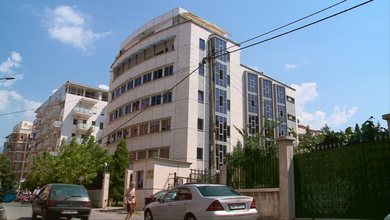



After the burning of the building built by Arlis Ndërtim at "Farmacia 10", construction experts warn that the lack of law and the permission of flammable materials for facades have turned Tirana into a minefield.
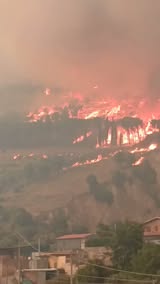
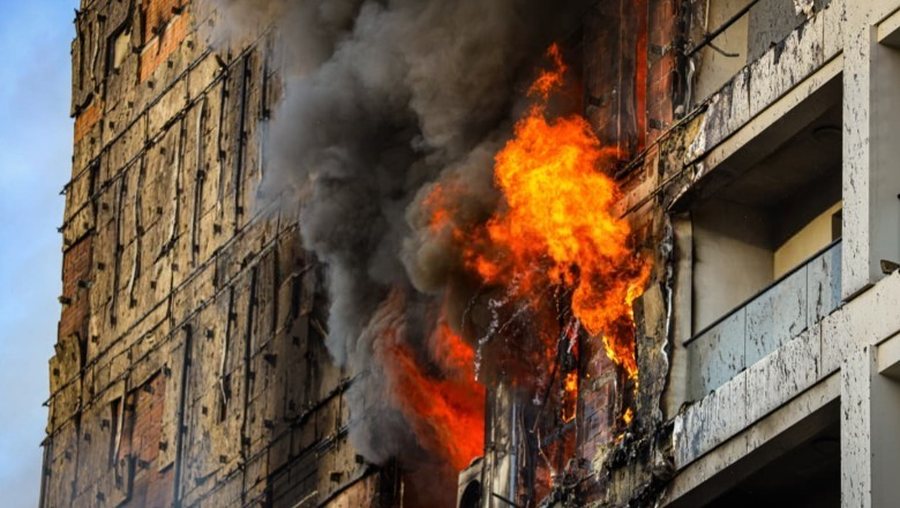
Smoke and hot steam continue to rise from the sooty entrance of the building in the area called "Farmacia 10" in Tirana, almost 24 hours after the fire that destroyed dozens of apartments and put hundreds of residents at risk since Tuesday afternoon.
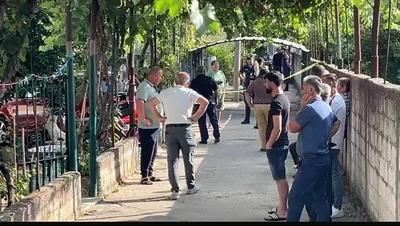
Inside the crime scene cordon, firefighters, military forces and forensic experts are working on the ruins. On the other side of the bandages, the residents of the burned building stand in despair. Tired and sleepless, they await news of their fate, after seeing all their wealth consumed by flames in a matter of hours.
Berti, a 40-year-old carpenter, says that nothing is left of the apartment he bought in the dump for 1,100 euros per m2.
"I saw it so I went with the fire engine to open the door, it was all burned," he says, while smoking a cigarette in the courtyard outside the bar.
Others who fortunately were not in the building when the fire broke out and were unable to enter even after the flames were extinguished, wait with eyes wide open from the building and in the hope that their apartment may have been spared.
Those who were inside when the fire broke out are happy to have escaped alive. An elderly man with his hair singed by the flames told BIRN that he was able to get out in time and save his granddaughter. He later ended up suffocating in hospital and by morning was coughing up soot-coloured secretions.
Police reported 11 injuries, mostly from smoke, including firefighters and residents, while the cause of the fire is still under investigation. Police arrested the manager of a supermarket on the ground floor of the building on Wednesday, suspecting that leftover supermarket paper caused the flames. The administrator contracted for the building's maintenance and cleaning, the engineer who implemented the project, and the administrator of the company that built the facade of the building that burned down were also arrested.
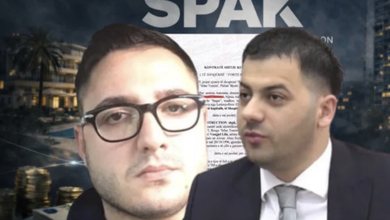
The owner of the company "Arlis Ndërtim", Armand Lilo, the investor of the complex and the administrator of the company that carried out the construction works, was told that investigations had begun.
As strange and ironic as it may seem, the search for the culprits may not yield results beyond the supermarket employees and the building administrator, as construction specialists told BIRN that there are no legal regulations for the materials used in building facades, nor are there any legal regulations that oblige companies to use fire-resistant materials.
"The main problem is that everyone operates within a framework that does not oblige them to implement clear standards for facades. This regulatory vacuum situation also creates an illusion of security, as buildings are certified and approved, but without actually verifying the facade's performance in the event of a fire," said urban planner Doriana Musai.
Construction engineer Erion Softa says the danger to citizens goes beyond facades with flammable materials, including the lack of roads for firefighters, the lack of fire alarms, and other problems.
“This is all an escalation,” Softa told BIRN. “There is no solution. There is no violation, because there is no law and there is no regulation.”
Through a statement to the media, the company “Arlis Ndërtim” distributed legal responsibility to subcontractors, emphasizing that “the building was successfully approved in 2021.” The company added, however, that it would assume social responsibility and repair the damaged facade and apartments.
The Shadows of Grenfell in Tirana
Albanian builders’ claims of “European-certified” materials often hide a danger that Europe has already learned at tragic cost. The incident in Tirana brings to mind the Grenfell Tower tragedy in London in 2017, where a fire started by an electrical appliance in an apartment gutted the 24-story building in a matter of hours, killing 72 people.
Similar to the case of the "Farmacia 10" building, investigations there proved that the cause of the fatal and unstoppable spread of the fire was precisely the external cladding of the facade with easily flammable plastic panels and fillings.
The tragedy forced the British government to radically change building laws, strictly prohibiting the use of these materials, but such legal regulation is lacking in Albania.
For the affected residents, it was fortunate that the fire broke out during the day and people were awake, as the flames erupted immediately.
“The facade was burning like paper,” says one of them, and shows that the flames suddenly flared up again at 2 a.m. on Wednesday. He says that everything burned down quickly and within 10 minutes the fire was out of control.
Doubts about the quality of the work and the safety of the building are hardly answered. On paper, everything is fine, or at least that's what the company claims.
The Arlis Construction company stated that the works had been checked and certified by the competent authorities, "guaranteeing the fulfillment of all technical and legal requirements."
Even Prime Minister Edi Rama completely avoided the responsibilities of the builder and the inspectors.
"The palace that burned down yesterday in Tirana will be rebuilt 100% by the builder himself, despite the fact that according to preliminary data, the cause of the fire has nothing to do with the construction itself!" Rama wrote on the X network.
On Wednesday, there were also no discussions about legal regulations on polystyrene and polyurethane thermal insulation materials applied to facades, despite the fact that this is the second building of the same company to burn in the space of four years.
Legal intervention is needed.
Unlike Rama and the construction company, urban planner Musai told BIRN that the use of easily flammable materials in the construction of high-rise buildings and the failure to meet fire safety standards were responsible throughout the chain, regardless of the cause of the fire.
"Responsibility is a chain and starts from the designer and builder, to the supervisor, the inspector, and the institutions that issue permits and certification," she said.
Musai points out that in most new buildings, including the damaged complex, polystyrene and polyurethane are widely used as insulating fillers, often combined with composite panels for external cladding. These materials are massively preferred by builders because they are economical, easy to install and offer high thermal efficiency, helping to meet legal criteria for energy saving.
However, the high content of plastic derivatives means that upon contact with flame, these materials not only burn at an extremely rapid rate, but also melt, releasing toxic gases and acting as a direct fuel for the building.
"In Albania, these materials are applied without a clear technical protocol. The material is certified as an individual, but no one tests how the entire facade system behaves when faced with flames," said Musai.
According to her, this risk becomes more critical in tall buildings and urban complexes where the vertical spread of fire on the facade "is very rapid and difficult to control."
"For this reason, buildings can be of high quality in appearance and energy, but unsafe in the event of a fire," she said.
Softa also says that the use of these materials has made the city dangerous, while emphasizing that the country needs to change the system.
"I was the head of testing results at the Construction Institute. There is no ban on materials, all materials are allowed, as long as they are not radioactive," said Softa, calling for legal regulations.
According to Softa, the changes must be fundamental to guarantee safety in construction, including reforming the Construction Institute.
"The system needs to be healed and it is not healed by the prime minister saying that if you insured the building, you are fine," he said, adding: "that insurance is like fixing a mattress after death, life does not come back." /BIRN/