The US is planning the long-term division of Gaza into a “green zone” under Israeli and international military control, where reconstruction will begin, and a “red zone” that will be left in ruins.
Foreign forces will initially deploy alongside Israeli soldiers in eastern Gaza, leaving this devastated strip divided by the “yellow line” currently under Israeli control, according to US military planning documents obtained by The Guardian and sources familiar with US plans.
“Ideally, you would like to get everyone involved, right? But that’s just an aspiration,” said a U.S. official, speaking on condition of anonymity. “It’s going to take some time. It’s not going to be easy.”
The US military's plans raise serious questions about Washington's commitment to turning the ceasefire announced last month into a lasting political solution with Palestinian governance throughout Gaza, as promised by Donald Trump.
Plans for Gaza's future have changed at a rapid pace, reflecting a chaotic and improvised approach to resolving one of the world's most complex and entangled conflicts, and to providing aid, including food and shelter, to 2 million Palestinians.
After weeks of the US promoting reconstruction in the form of fenced-off camps for small groups of Palestinians, called "alternative safe communities" (ASCs), those plans were abandoned this week, the US official said.
“This is a view of a concept that was proposed at a certain time,” the US official said. “They have already moved beyond that plan.” Humanitarian organizations, which have expressed serious concerns about the ASC model, said they had not yet been notified of the change in plans.
Without a workable plan for an international peacekeeping force, the withdrawal of Israeli troops, and large-scale reconstruction, Gaza risks being stuck in a vacuum after two years of devastating war.
Mediators have warned of a "no war, no peace" situation in a divided Gaza, with regular Israeli attacks, a deep occupation, a lack of Palestinian governance and limited reconstruction of Palestinian homes and communities.
The creation of an International Stabilization Force (ISF) underpins Trump's 20-point plan. The US hopes a draft UN Security Council resolution giving the force a formal mandate will pass early next week, and expects to outline the details of the troops' commitments then.
“The first step is to adopt the resolution,” the US official said. “States will not make strong commitments until they see the text that has been adopted.”
Trump has ruled out deploying US troops on the ground to facilitate the Israeli withdrawal, or to fund reconstruction. “The US has been very clear: they want to set the vision, but not pay for it,” said a diplomatic source.
Earlier this month, the US regional command Centcom drew up plans to deploy European forces, including hundreds of British, French and German soldiers, to the ISF hub, according to documents obtained by The Guardian.
These plans include up to 1,500 infantry soldiers from the UK, with expertise such as bomb disposal and military medicine, and up to 1,000 French troops for security and road clearing.
The US also requested troops from Germany, the Netherlands and the Nordic countries for field hospitals, logistics and intelligence.
One source described the plans as “delirious.” After long missions in Iraq and Afghanistan, few European leaders would be willing to risk the lives of their soldiers in Gaza, although they have promised other support. Only Italy has offered a possible troop contribution.
The documents were classified as non-confidential, suggesting that the US did not consider the military plans too sensitive, and they clashed with reality within days.
The figures presented in the documents contained "many inaccuracies" and Washington did not expect European troops to form the core of the ISF, a US official said, adding that planning for Gaza was moving quickly.
“It’s very dynamic. It’s very fluid,” the U.S. official admitted. “There are only a few people who understand and have this plan in their hands.”
Jordan was also offered the possibility of contributing hundreds of light infantry troops and up to 3,000 police, although King Abdullah has explicitly ruled out sending troops, arguing that his country is "very politically connected" to Gaza.
Over half of Jordanians are of Palestinian descent, and agreeing to patrol the ruins in coordination with Israeli forces would be an extremely unpopular threat to Jordan's national security.
Until Thursday, the US military was expecting major contributions from a broad group described as "NATO and partners," which included countries from Europe, Asia and the Middle East.
A US “operational concept” for the ISF specifies that the troops will serve only in the “green zone.” The US envisions an “initially small-scale” deployment of a few hundred troops, then gradually expanding to 20,000 troops throughout the area.
They will not operate on the western side of the “yellow line,” where Hamas is regaining control. “You will not leave the Green Zone,” the US official said.
Another document envisages foreign soldiers controlling border points along the Line of Control after "integration" with Israeli forces stationed there, a mission that could unsettle potential contributing countries.
They fear being caught in the crossfire between Hamas and Israeli troops, and the borders are often flashpoints. They also worry that they could be accused of supporting the ongoing Israeli occupation of Gaza.
The Israeli military will "consider the terms of withdrawal" at a later stage when international security is established, without setting a timeline.
The reunification of Gaza is part of the process to "lead it towards stabilization and lasting peace and a transition to civilian governance," the US official said, adding that it was impossible to set a date for when this might happen.
Trump’s 20-point plan describes a new Palestinian police force as the “long-term internal security solution” for Gaza, but US planners have given it only a limited role. The plan calls for an initial 200 recruits, growing within a year to a force of 3,000–4,000 officers, which is just one-fifth of the security plan.
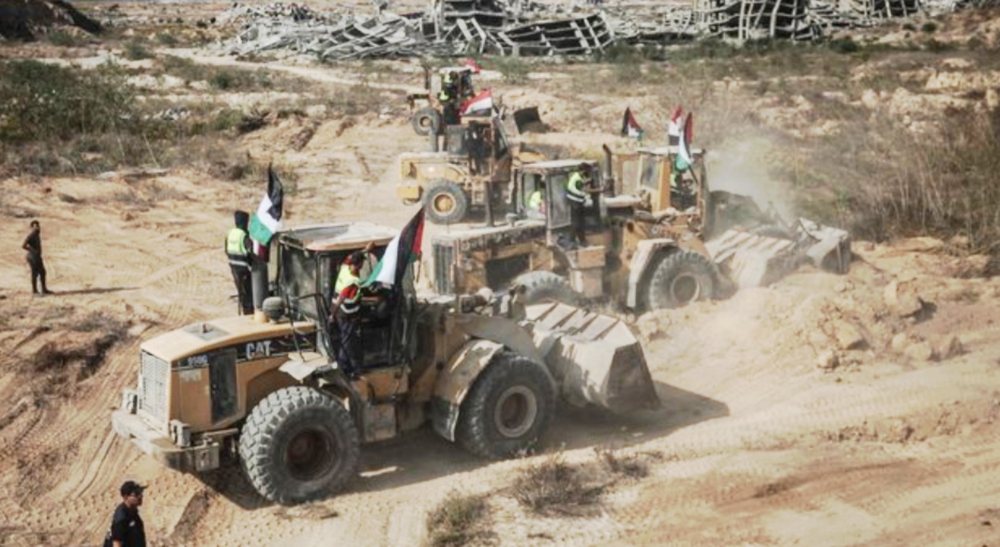
Reconstruction of
US military planners see reconstruction within the "Green Zone" as part of an unclear path to reunifying Gaza, persuading Palestinian civilians to cross the Israeli line of control.
“As things progress and the conditions are created for significant progress in reconstruction, Gaza civilians will start to move there and survive,” the US official said. “People will say, ‘yes, we want this,’ and everything will evolve towards that. No one is talking about a military operation to force it.”
However, even marking a "green zone" in Gaza risks resembling Iraq and Afghanistan, where the term became synonymous with American military failures.
In Baghdad and Kabul, the Green Zones were enclaves surrounded by concrete barriers, where Western forces and their local allies retreated to escape the violence their mission had caused in surrounding communities. The plan to use aid to draw the population of Gaza into an area under Israeli control, after two years of war that a UN commission deemed genocidal, bears similarities to other disastrous American policies from those conflicts.
About a decade before the Taliban took Kabul, the US claimed it was bringing “government in a box” to southern Helmand to win over civilians. The province remained an insurgent stronghold.
Trump’s 20-point plan commits to the demilitarization of Palestinian factions in Gaza and an eventual Israeli withdrawal to a “security perimeter” formed from Palestinian land. This would be facilitated by the ISF and would allow the start of reconstruction “for the benefit of the people of Gaza.”
The need for reconstruction is urgent, with over 80% of buildings damaged or destroyed during the war, including almost all schools and hospitals, according to UN data.
More than a month after the ceasefire, Israel continues to restrict aid deliveries to Gaza, banning even basic items, such as tent poles, which it classifies as "dual use" because they can be used for military purposes.
Nearly 1.5 million Palestinians are waiting for emergency shelter supplies, and hundreds of thousands more live in tents without access to basic services such as clean water. Almost the entire population, over 2 million people, is confined to the red zone, a strip along the coast that covers less than half of Gaza's land area./ The Guardian/