



For years, municipal revenues have been dependent on the infrastructure impact tax, which is collected from new construction and has systematically accounted for more than half of them. But this year, this dependence has also been transferred to the central budget, exposing the national economy to unsustainable developments in this sector.
Official data from the Ministry of Finance shows that, in the first five months of 2026, 15.3 billion lek were collected from the infrastructure impact tax, an increase of 240% compared to the value of 4.5 billion lek that was collected in the same period of 2025.
The additional revenues from the infrastructure impact tax in the five-month period were 10.8 billion lek, which accounted for 31% of the additional revenues in the total budget during the same period. Instead of the growth of budget revenues being driven by VAT and other tax items, which come from the production and services sector, this year showed an increase in the dependence of the national budget on construction. Also, in the additional revenues of the local budget, revenues from this tax accounted for 87%.
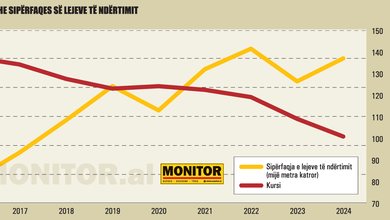
Official data shows that revenues from taxes on new construction reached a historic record this year, as 15.3 billion lek were collected in just five months, while in the best year, 2024, collections from this tax were 18 billion lek for the entire year (see chart below).
The infrastructure impact tax accounted for about 54% of all local government own revenues in the first five months of the year. Within the group of local taxes, its share reached about 64%.
This means that more than half of the revenue that municipalities generate themselves now depends on a tax directly linked to the construction market.
High revenues from the infrastructure impact tax create more opportunities for municipalities to finance investments and public services. However, the high weight of this tax makes the financial situation of local governments increasingly linked to the performance of the construction sector.
Unlike a property tax, which can generate recurring revenue each year, an infrastructure impact tax is paid when new construction is approved and developed. As a result, revenues can drop significantly if permitting slows, major projects are completed, or demand in the real estate market weakens.
Recent meetings of the National Council for Territory and Water have reviewed several hundred requests for construction and development permits, including tourist and residential projects, public infrastructure, as well as interventions in the energy and transport sectors. This is an indicator that warns of the economy's further exposure to the construction sector./ Monitor.al