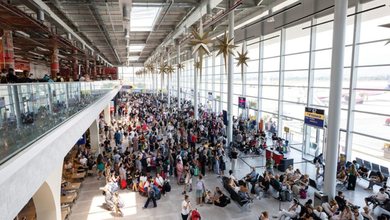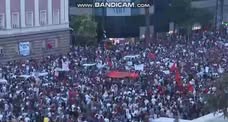



Almost at the end of the year, businesses in the tourism sector cannot clearly say whether 2025 was a year of success or decline.
Tour operators claim that in terms of visitor numbers, this year remains good, with a moderate increase that has come as a result of spring and autumn cultural tours.
In relation to the income generated, businesses in the sector are skeptical. The typology of tourists, mainly young, looking for experiences but without spending much, has brought less income for them. This result comes as an effect of a "marketing" that you cannot control.
It is the virality of videos on social networks that has convinced a good portion of tourists that Albania is an experience to try and, above all, very cheap, and it is they who have sought the cheapest options possible.
Accommodation was dominated by apartments or hostels, while consumption was dominated by shopping at supermarkets or fast food outlets. Of course, this does not apply to all tourists, but this was the predominant typology.
The balance has been made by tourists coming on cultural tours and senior citizens from Western Europe, who do not see the experience of Albania as a "check-in" but as a period of relaxation with more choices from the tourist offer.
There are tourists, but they are thrifty, the progress of 2025
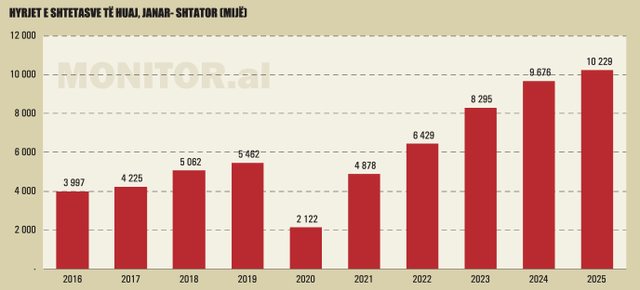
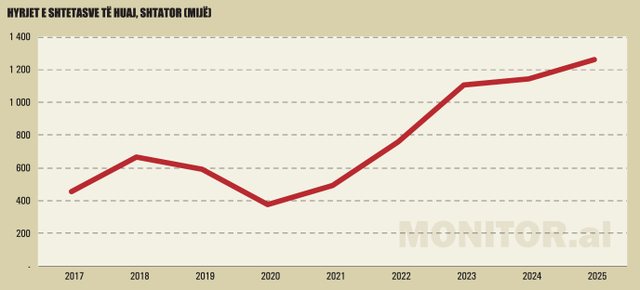
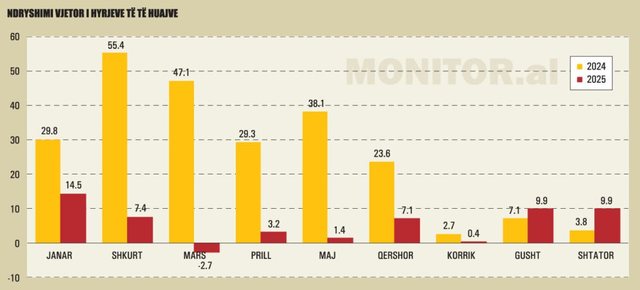
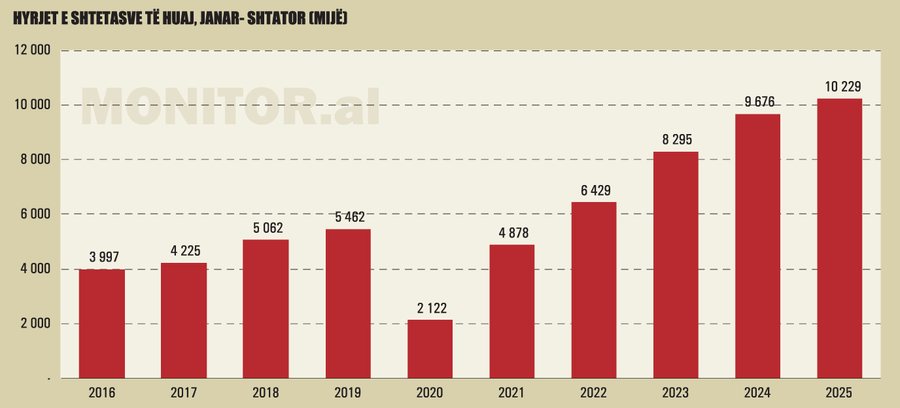
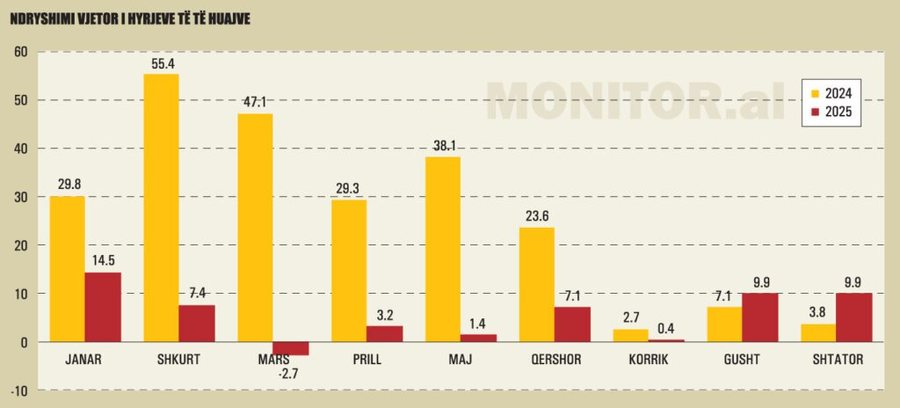
By the end of October, 11.1 million foreigners visited Albania. At least, this was the figure reported by the Ministry of Tourism, Culture and Sports, with a 7% increase compared to January - October 2024.
This year is likely to record a somewhat lower growth than the previous year, but in total to exceed the 11.7 million visitors recorded by the end of 2024.
Despite a higher number of foreign arrivals, consumption has been weaker, leaving less money in the economy.
In terms of visitor numbers, we are at the expectations we had, meaning that this year would be the same as 2024. Perhaps the summer season could be considered a little weaker. They were low-cost tourists who chose Tirana, rural areas, and agrotourism.
"A characteristic of this summer season was the decline in quality tourists, that is, those who pay more and require more services. There was a decline in this group compared to 2024," says the President of the Albanian Tourist Union, Rrahman Kasa.
The change in tourist typology seems to be directly related to the form that influenced the choice of these foreigners to come to Albania, and most of them referred to social networks.
The virality that our country gained on social networks, which was initially associated with natural beauty, good food, and cheap prices, seems to have turned into a boomerang that has attracted more and more "savers" in a kind of "race" for the cheapest experience.
"It's not that we didn't have tourists this summer. Maybe we had the same or more, but what made the difference is the typology of the tourist."
This is a new typology dominated mainly by young people who prefer to spend little and create experiences.
"They are looking for cheaper alternatives. This age behaves like this everywhere, not just in Albania," claims Arben Çipa, from "Sipa Tours".
Autumn corrects summer, cultural tours increasingly popular
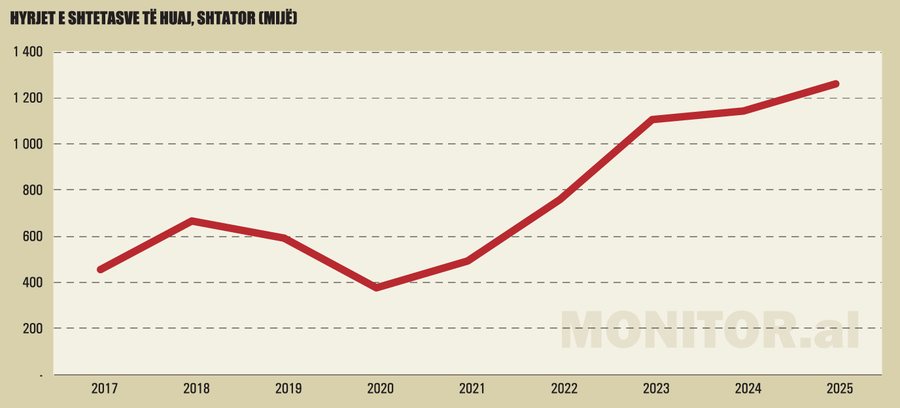
While summer presented a bleak situation for tourism, spring and now autumn improved the tourism balance of the year.
Tour operators say that this period has been a positive one and foreigners are increasingly preferring to visit the most culturally important cities in an organized manner, usually over one-week periods.
"Autumn is very good. There is a steady increase and many groups coming with organized cultural tours. Likewise, there are also many individual tourists who spend little and choose to stay in AirBNBs."
Cultural tours have been more sustainable. They are tourists who also spend a little more and choose to stay up to seven nights, moving around and exploring different places.
They visit the North, namely Valbona and Theth, visit historical places such as Berat and Gjirokastra and also stop in Saranda. So far we can say that the numbers are satisfactory”, – underlines Mr. Kasa.
The same trend is confirmed by Mr. Çipa, who, among the autumn months, singles out September, which made a difference for the balance of sand and sea tourism.
Cultural tours, especially concentrated in October and November, remain at satisfactory levels.
"A mix of independent tourists, meaning those who come individually, and tour operators who bring visitors on cultural tours in an organized manner has been noticed."
"The latter have had a satisfactory pace and even today, now that we are in November, the figures for cultural tours remain at good levels," he claims.
From service to water shortages and infrastructure, points we need to reflect on
During this year, services in the tourism sector have continued to show the pressure brought about by the lack of ordinary, but especially qualified, labor force.
Mr. Çipa states that the service here still remains elementary.
He believes that perhaps next year he will find the sector more prepared because foreign workers are constantly being recruited.
"Maybe we can evolve a little in the service, since we are hiring most of the staff from abroad and this will enable us to improve somewhat, but the emphasis should be placed on the professionals of the sector who are the key points", underlines Mr. Çipa.
During this year, for various regions in the country, problems were also pronounced in basic services, which are inconceivable for tourist areas.
Among them are the lack of water in the Golem area, the lack of energy in some areas, and the burning of waste in Vlora. For Mr. Kasa, these are elements that worsen the overall tourist assessment of Albania.
"The main problem has been the lack of service. Tourists have had reservations about this and have not hesitated to express it as a complaint either to their agencies or in conversations."
When you pay 300-400 euros for a room, it's inconceivable that you have to wait 20 minutes for a coffee, which is the simplest thing.
We have continuously raised other problems. The main complaints are about construction sites that remain open during the season.
So, entities build right next to accommodation structures and this turns vacation into a stress for tourists.
"The noise caused by the construction around the clock, the inertness, but also the appearance of the unfinished buildings is not at all welcoming to the eye of a tourist and does not give you the impression that you are in a tourist area," Mr. Kasa underlines.
The year 2026 is expected to have the same performance as the current year, without surprises.
The year 2025 is expected to end with a positive balance for the entry of foreigners into Albania, where growth is expected to be weaker than that of the previous year.
Tour operators say they do not expect any surprises next year, which means that the sector's performance is expected to remain positive, but growth rates will be slower.
The typology of tourists is also expected to remain the same as this year, given that social networks are leading the way in marketing.
Organized tourism will once again be dominated by Poles, while individual tourism will be dominated by Kosovo and Italy, although these two groups are showing fluctuations from time to time.
We need to look carefully at these trends, because Kosovo Albanians and Italians are the two largest groups in unorganized tourism, while Poles are the largest in organized tourism, and the trend is likely to remain the same next year.
France, on the other hand, although on the rise, has a small number of tourists. Israel is another market that has seen growth. There are at least 100 thousand tourists who came from this country from April to October.
"The idea is that there is still interest for Albania, but we need to reflect and make our own corrections so as not to lose ground. The chances are that 2026 will be the same as 2025," says Mr. Kasa.
Even for Arben Çipa, the expectations are the same for next year, both in terms of income and the type of tourist.