



Albania allocates much less funds from the public budget for social protection in relation to GDP than other European countries.
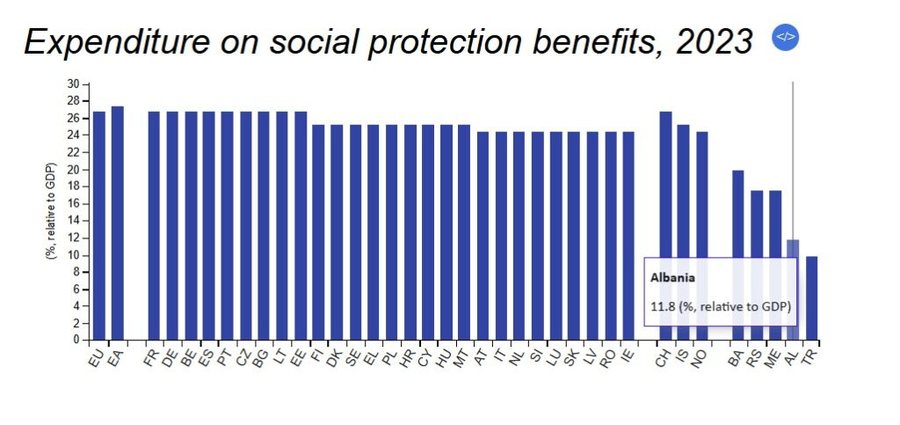
According to a Eurostat comparison dating back to 2023, European Union countries spend on average over 25% of GDP on social protection, while Albania only spends around 11%, placing it at the bottom of the list, leaving only Turkey behind.
The contrast with the European average is stark, with countries like France, Germany, Belgium, or even the eurozone average spending approximately two to three times more on pension schemes, economic assistance, unemployment policies, or other social benefits than Albania.
Even countries in the region, such as Bosnia and Montenegro, report significantly higher percentages than Albania, further deepening the regional gap (see chart).
This data raises questions about the support that social systems in Albania manage to provide, especially in a period of rising living costs and increased pressure on low-income families and pensioners.
The large gap with the European average suggests that the current social protection system remains weak compared to EU standards, while the social needs of the population increase year by year.
In 2023, total spending on social protection benefits in the EU reached €4,607 billion, which was equivalent to 26.7% of gross domestic product (GDP).
An analysis by function reveals that the highest level of expenditure in the EU was recorded for pensions which accounted for almost half (46.9%) of total expenditure on social protection benefits in 2023.
The rest, healthcare compensation, took up 29.6% of EU spending on social protection benefits, while the remaining functions are at lower levels.
In Albania, almost 88% of spending is on social protection and only 12% is allocated to other items, such as health, economic assistance, etc. /Monitor.al/