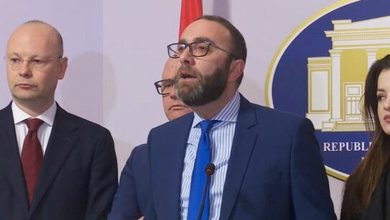



 Democratic Party MPs, members of the Council for Rules of Procedure, Mandates and Immunity, climbed the steps of the Assembly Presidency in vain on Tuesday, waiting to hold the meeting they requested to review the Special Prosecution's request to lift the immunity of Deputy Prime Minister Belinda Balluku.
Their request was rejected for the third time by the Speaker of the Parliament, Niko Peleshi.
Peleshi did not respond to BIRN's questions on Tuesday about the reasons for the indefinite postponement of the Council's convening since its only meeting held on December 19, while one of his advisors referred to an official response he gave on December 24 to opposition members.
In this letter, Peleshi justified the refusal to call the meeting with the request of Balluk's defense for 3 weeks to familiarize themselves with the relevant documentation in order to conduct a due process.
"As long as this process has not been concluded and the parties have not been provided with the necessary time to exercise this right, the procedural conditions for setting a new meeting date are not met," the Speaker of the Assembly wrote in response.
The opposition rejects Pelesh's argument and accuses the latter of committing a criminal offense by refusing to convene the Council.
"Today, the 3-week deadline given to Balluk also ended. Starting tomorrow, every second of delay means abuse of power by Pelesh," declared the head of the DP parliamentary group, Gazmend Bardhi, on Tuesday.
The granting of authorization to impose a security measure on a deputy is provided for in Article 118 of the Rules of Procedure of the Parliament, without clear deadlines for prior review. According to this article, the Speaker of the Assembly is obliged to forward the request of the Prosecutor's Office and the accompanying documents to the members of the Council and the deputy in question, while informing the latter of the time at which the Council on the Rules of Procedure, Mandates and Immunity will begin reviewing the request.
At the conclusion of the review, the Council, within 2 weeks, drafts a report for the plenary session, in which it recommends the rejection or approval of the granting of authorization, and the review of this request is placed as the first item on the agenda at the next session.
According to legal experts, in the Balluk case, the Assembly is indefinitely postponing the review of the Special Prosecution's request, which, according to them, contradicts the spirit of the legal provisions and sets a dangerous precedent for the Assembly's stance.
Erida Skëndaj, head of the Albanian Helsinki Committee, told BIRN that the indefinite postponement of the meeting of this council “is not in the spirit of Article 118 of the Rules of Procedure of the Assembly and the provisions of the Code of Criminal Procedure, and violates the constitutional principle of equality before the law.”
Skëndaj argues that the failure to set clear deadlines in the Regulation has created an artifice to delay the process, exploiting a legal loophole to the detriment of administering the investigative process within a reasonable time, as is currently happening. On the other hand, Skëndaj emphasizes that it is considered a “violation” to not respect the provision of the Assembly Regulation for the Council meeting when this is requested by ½ of its members.
“This behavior harms the activity of the justice bodies tasked with fighting the impunity of high-level officials,” said Skëndaj.
For lawyer Gentjan Serjani, "this case creates a dangerous institutional precedent, where political stance is placed above legal obligation."
“Such an approach violates the principle of the rule of law and implies that, although the Regulation was adopted by consensus to be strictly implemented, political interests have dictated the deviation from its “letter-for-letter” implementation. Such a practice undermines the credibility of parliamentary institutions and the authority of the Assembly’s Regulation itself,” he said.
According to Serjani, the behavior of the members of the Council of Mandates and Immunity clearly proves the malfunctioning of the Rules of Procedure of the Assembly in this specific case, and this structure, which was supposed to guarantee respect for procedural norms, is precisely the one that has committed a flagrant violation of point 6 of article 13 of the Rules of Procedure of the Assembly.
“This provision expressly stipulates that the Council meets at the request of the President of the Assembly or half of its members, that the agenda is set by the President, and that the meeting is valid only when no less than five members are present. Failure to comply with these procedural criteria constitutes a direct and unjustifiable violation of the Rules of Procedure,” Serjani argues.
The Assembly cannot play the role of a court.
Although the main justification for the indefinite postponement of the meeting on Balluk's immunity is related to gaining sufficient time to familiarize themselves with the evidence brought by SPAK, none of the socialist MPs, members of this Council, have withdrawn the USB with 16 thousand pages submitted to the Assembly.
Prime Minister Rama himself acknowledged this fact at the annual media conference, while ironizing the contents of the file as being filled with archival documents from the ministry.
"The USB brought by the Prosecutor's Office has not been withdrawn by any SP MP and neither has the minister or the lawyer. To be very clear. To not create any path for others to say 'they brought this or that,'" said Rama, leaving open the possibility of SPAK's request being rejected.
“The Mandates Council is not a notary office, it is a quasi-court, and Parliament does not notarize the requests that come in,” he added.
Lawyers, however, argue that the Mandates Council cannot act like a court and that its duty is only to see if the prosecution's request is legally correct and not to undertake to review investigative evidence.
"According to the standards of the Venice Commission, if the request for limitation of immunity is examined in detail, in addition to contradicting the principle of the presumption of innocence, it creates the public perception that we are in the conditions of a political process," said Skëndaj from the Albanian Helsinki Committee.
Consequently, she adds, "the arguments for indefinitely postponing the Council meeting, to gain time to read all the documents in the file, harm the efficiency of the investigation, as the Council is not a judicial body, creating the conditions for favoring the public official, especially when he continues to hold high public positions."
Even for the DP member of this Council, Oerd Bylykbashi, the Assembly cannot return to court and review the prosecution's investigative evidence, but only sees whether the prosecution's request is not political in nature.
"I received it, but I did not open the prosecution's USB, because as an MP, I am convinced by the SPAK report, which refers to sufficient data why security measures are required for the minister," said Bylykbashi./Taken from Reporter.al