


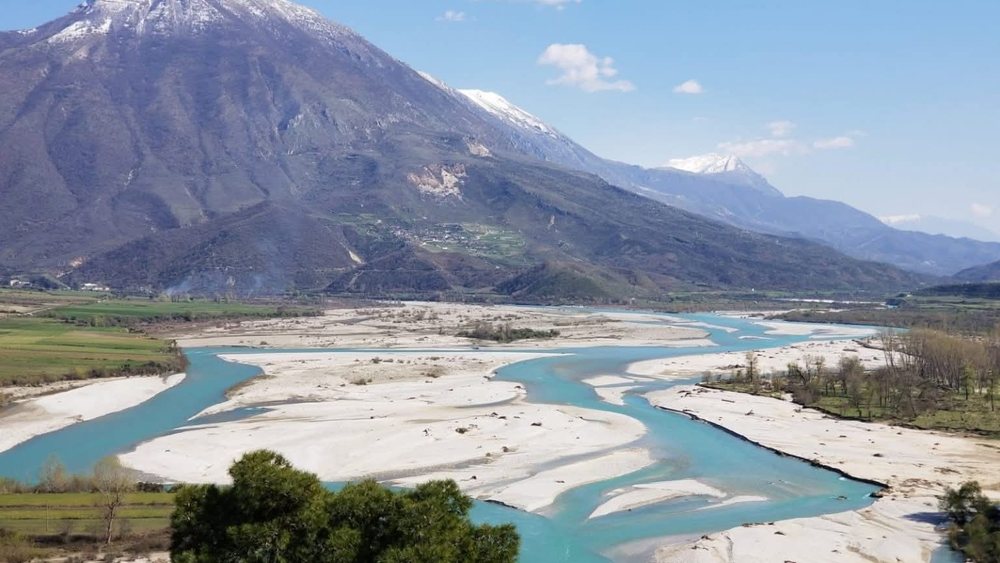
The Vjosa River, known as “the last wild river in Europe,” was declared a National Park two years ago, following a years-long international campaign that brought together local activists and Hollywood actors. Although the level of legal protection has increased, its course continues to be threatened by pollution.
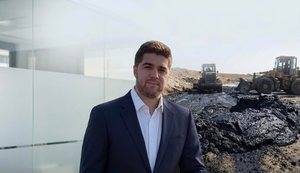
"All these minerals are highly loaded with chemicals, that is, chemical substances that deteriorate water quality," Olsi Nika told BIRN.
"There are substances that are harmful to flora and fauna, but there are also other substances called components that persist and do not decompose," he added, explaining that "they not only pollute the flora and fauna there, but through food webs they come to our tables, to our tissues."
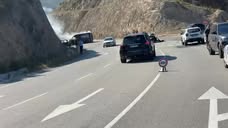
The scenes on the ground are dramatic, while environmental protection institutions speak of the quality within the norms of rivers that continue to be polluted.
However, in a written response, the National Environmental Agency told BIRN that, based on the annual environmental report, river waters are assessed to be below the limits set in national standards and do not present pollution.
"Regarding the total alpha and beta radioactivity values of the waters of the Shkumbin, Drin and Vjosa rivers, they are assessed to be below the values set in national standards and do not represent pollution," writes the KTA.
Habitats at risk
Rivers in Albania constitute one of the country's most important natural resources, with a dense network of streams descending from mountainous areas to the coastal lowlands. Unlike the rest of Europe, many of Albania's rivers still retain wild segments, creating rare natural habitats and ecosystems.
However, they are under constant pressure from mining activities, industrial waste, hydrotechnical interventions, and poor waste management, making their preservation a significant environmental challenge in Albania.
Similar to the Vjosa, the Fan River winds through valleys and mountain gorges and reaches the town of Fushë-Arrëz in crystal clear water. It is there that it joins the red stream that comes from the mining area and its flow changes color from pollution.
River pollution is not always a consequence of active mining, but also of old inherited mineral deposits.
In Kukës, near the Leshnica bridge, mineral dust and waste create a permanent cycle of pollution that ends up in the Drin River. A similar situation exists in Librazhd, where old mining waste on the banks of Shkumbini, after every rain, ends up in the riverbed.
Experts raise doubts about the institutions' methodology for measuring river pollution.
“If the KTA says, for example, that the Vjosa or Fani has good or very good water quality, it refers to the entire length of the Vjosa or Fani,” explained Nika.
"But these pollutions are point-based, which become diffuse, distributed over several hundred meters or up to four kilometers, and then the water cleans itself," he added.
The head of Eco Albania insists that the damage caused by pollution begins primarily with communities living near areas where mining companies operate.
"The chain is simple: waste or chemicals or harmful waste are deposited in the water, starting from the water to the filter feeders that are the first — that is, from algae, to the macroinvertebrates that fish, birds feed on, and then on which we also feed," said Nika.
"This is the main problem of pollutants: not only do they damage the area, the habitats, the part where they are discharged, but they also pose a high risk to human health — primarily to the communities in the areas near them that exploit these natural resources," he emphasized.
Administrative measures
The National Environmental Agency explains that its inspection groups have taken administrative measures, imposing fines and requesting the suspension of activity for several mining companies, including those in Selenica and Fushë-Arrëz.
“Environmental pollution does not wait,” says environmental expert Edi Tuka. “So it does not wait for a decision from the KTA or other law enforcement institutions, which will not only suspend and revoke their licenses; they must definitely intervene with great force in terms of the activities of these companies that pollute the environment,” he added.
The same concern is raised by environmental expert Olsi Nika, who emphasizes that sanctions should be higher in order to truly influence the behavior of mining companies.
"A million old lek fine for a company that generates several million euros a day is not a problem at all," he said.
The lack of a decisive response from the institutions responsible for stopping the pollution has produced apathy and silence in the affected communities.
"If the community does not have law enforcement institutions on its side, but faces them - and the evil that is environmental pollution, the community normally loses the strength and reason to continue in the cause of environmental protection," said Tuka.
In the absence of this support from institutions, communities affected by pollution seem to have no choice but to remain silent and try to make whatever small compromises the polluting company offers them.
“They can withstand both the pressure of the money they can get from companies, and the pressure of the ‘strongmen’ who represent or protect the interests of these companies if they see a reaction from the state,” Nika said. “But when they don’t see any reaction from the state, it’s easier for them to compromise,” he added.
Environmental crime
While authorities insist that official monitoring shows waters within norms and that administrative measures have been taken against companies, footage from the ground shows that rivers remain exposed to ongoing pollution, while the impact on natural habitats and the health of residents is difficult to ignore.
Environmental experts are critical not only of the KTA, but also of law enforcement agencies. According to Mihallaq Qirjo, executive director of REC Albania, the number of criminal offenses related to environmental crime that are prosecuted by thue police is very low – only 17% of all criminal offenses affecting land, water and air.
"If we go to the prosecutor's office, the number drops significantly: the average is 0.4% of all offenses handled by the prosecution are in this criminal offense that affects the air, water and land," he said, adding that in most cases, investigations are suspended due to the absence of perpetrators of the crime, or dismissed due to the lack of evidence collected in the field.
“In court, we have not found a single case of conviction due to pollution of water sources,” explained Qirjo, adding that this situation stems from “the lack of human and technical capacities to investigate environmental crime in depth.”