


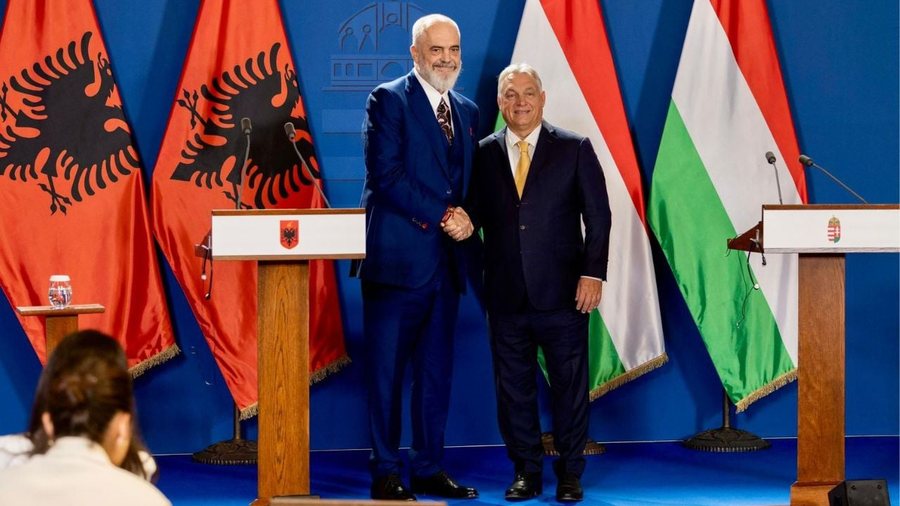
Taken from "The Parliament" magazine
Brussels may have marked Albania and Montenegro as the next countries to join the European Union, while recent elections in Moldova gave a clear pro-EU mandate to pro-Western forces. But one member state is becoming the biggest obstacle to the union's expansion: Viktor Orbán's Hungary.
As the war in Ukraine rages and the Kremlin seeks to expand its influence in the former Soviet space, EU enlargement has turned from a distant goal into an urgent geopolitical necessity. However, the process that once symbolized European unity after the Cold War is now in tatters. The unanimity rule within the EU means that each member state has a veto on every enlargement step, giving Orbán the power to block one of the most important decisions in the union’s foreign policy in decades. Budapest has used this power repeatedly — to delay the opening of talks with Ukraine, to demand the release of frozen EU funds to Hungary, or to win concessions in other policy areas.
“Orbán has used the Ukraine blockade as an instrument to gain more favors within the EU,” Andi Hoxhaj, a lecturer at King's College London, told The Parliament.
Today, with candidate countries losing patience and Moscow watching closely, the EU faces the dilemma of how to keep the enlargement process alive while one of its members obstructs it.
Orbán’s stance on enlargement is less ideological and more transactional. He has supported several Western Balkan states — but only those that align with his political and economic interests. “When he says he supports the Balkans, he means Serbia and Bosnia and Herzegovina, especially Serbia,” says analyst Tefta Kelmendi. “This is directly related to the personal relationships that Orbán has with important actors in these countries.”
Hungary and Serbia are closely linked by major energy deals. A new oil pipeline expected to be operational by 2028 could meet all of Serbia's energy needs, while Hungarian energy company MVM has become a majority shareholder in two Serbian companies. In Bosnia's Serb entity, Republika Srpska, Budapest has also invested in several important energy projects.
But Orbán’s regional enthusiasm stops at the Ukrainian border. Budapest has been the staunchest opponent of Kiev’s bid, arguing that Ukraine’s membership could drag the EU into war and drain the union’s financial resources. He also uses the protection of the rights of the Hungarian minority in the Transcarpathian region as an argument. Critics have often called Orbán Vladimir Putin’s “Trojan horse” in Brussels, as he is one of the few EU leaders to have maintained close relations with the Kremlin even after the full-scale invasion of Ukraine in 2022.
“If Ukrainians become members of the union, this war will also become our war,” Orbán said at a meeting of the European Council.
“And we don’t want that.” Behind this rhetoric is also the fear of losing European funds: between 2014 and 2020, Hungary received around 25 billion euros in cohesion and agricultural funds, which accounted for around 4% of its GDP. Ukraine’s membership means that part of the EU’s common budget could be redirected away from Hungary.
Orbán has turned the threat of a veto into a political bargaining chip. In 2023, he walked out of the Council chamber to allow the other 26 leaders to approve the opening of negotiations with Ukraine — just hours after the Commission had unblocked 10.2 billion euros in frozen funds for Hungary. “The EU has previously withheld funds from Budapest because of corruption, lack of judicial independence and misuse of public funds,” Hoxhaj recalls. “So Orbán will continue to play the same game.”
The same strategy was seen during Sweden’s NATO membership process, which Hungary ratified only after reaching an agreement to purchase four Saab Gripen fighter jets. With national elections on the horizon and growing discontent at home, Orbán has stepped up anti-Brussels rhetoric, portraying European support for Ukraine as a plot to overthrow his government.
“Let’s have no illusions: Brussels and Ukraine are jointly building a puppet government in Hungary,” he declared in June. “They want to change our country’s policy towards Ukraine after the next elections — or even earlier.”
Since 2022, Moldova and Ukraine have been at the heart of the EU’s new enlargement push. The two countries are following the same trajectory, following the previous strategy of pairing applications from regions with similar challenges. In 2004, eight post-communist states joined the EU at once, followed by Bulgaria and Romania in 2007. But this approach has not always worked. For years, Albania and North Macedonia were treated as a package deal; while the name dispute led to Greece vetoing Skopje, automatically blocking Tirana’s path.
“The EU did not learn lessons from the Balkans in this regard,” Kelmendi emphasizes. “First, because of the potential bilateral conflicts between countries, and second, because one country that is stuck can hold another one hostage. This approach has shown that it slows down the process more than it helps it. Therefore, membership should proceed on the basis of the merits of each country.”
Hungary’s blocking of Ukraine risks having a knock-on effect on Moldova, which recently gave President Maia Sandu and her pro-EU party a strong mandate to move closer to the union. Although Orbán claims to support Moldova’s membership — seeing it as a new source of labor for the EU — the obstacles he places on Ukraine directly damage the credibility of the enlargement process and affect countries like Albania that have been waiting for the crucial step toward membership for years.