


By Muriel
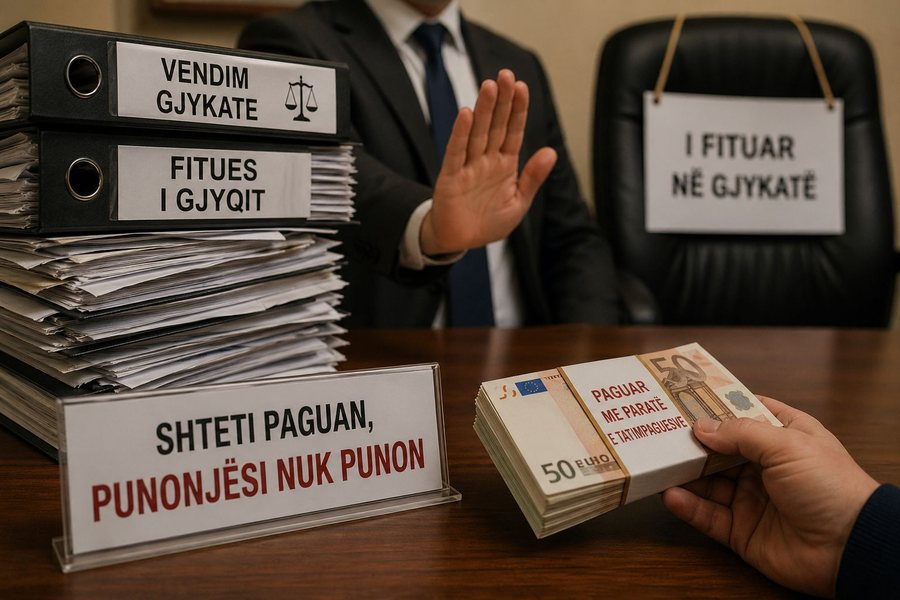
In Albania, there is a category of “civil servants” who are regularly paid from the state budget, but are not allowed to enter the office. These are neither people on maternity leave nor on temporary medical disability; they are the winners of lawsuits against the administration, who, by final decision, should have been reinstated long ago. While the court orders reinstatement, the heads of institutions often order the blockade, creating a financial hemorrhage where the citizen pays twice: once for what is sitting in the office chair and a second time for what is staying at home by court order.
This absurdity of payments for “undone work” is a direct consequence of administrative arbitrariness, where when an institution refuses to implement the decision to return to work, it is not saving the budget, but openly sabotaging it. For every month of delay, the bill for arrears of wages and interest on arrears automatically increases, turning into the purest economic damage that can be done to a state: full payment for zero service. In our state balance sheets, these costs do not appear as investments, but as liabilities that stem from the whims of a head of state, who prefers to burn public money rather than accept the authority of the law.
This situation proves the existence of an administration that pays for disobedience, creating a deep crisis of the rule of law where, according to official data, flagrant cases of delays often exceed the limit of five or ten years. It is unimaginable that an employee receives over 100 monthly salaries without breaking a single day in the institution, simply because a manager refuses to sign the acceptance protocol. This model turns the institution into a private fiefdom where public money is used as currency to buy the luxury of disobedience, turning the state budget into a “place of asylum” for deliberate failures in human resources management.
To stop this practice, the need for individualizing responsibility and applying civil recourse is immediate, as the current standard where the “institution” bears collective responsibility must end once and for all. If a court decision is not implemented within six months, the financial cost should no longer be billed to the general budget, but to the specific official who has the power of the firm. The state should forcefully activate recourse lawsuits so that, when a headman knocks on the bailiff's door to his personal account to repay salaries paid out of personal grudges, the law is enforced immediately and without hesitation.
In this context, the role of the Supreme State Audit Office is crucial to conduct a nominal audit on unjustified salaries and to stop this financial massacre that can no longer be treated with general findings. The Supreme State Audit Office must demand specific accounts for every file kept in a drawer and for every refusal to create vacancies, considering every penny paid to a dismissed employee as abuse of office in the purest sense of the law. The audit recommendations should not remain simply archival documents, but should be accompanied by firm demands for compensation from the persons who have caused these unjustified delays.
In conclusion, it must be understood that justice itself does not cost anything, but what does cost society dearly is arbitrariness, since no reform in administration can be successful as long as the culture of impunity exists. A state that pays people not to work, simply to satisfy the ego of a superior, is a state that is sabotaging its own future. The solution is no longer technical, but financial and penal; court decisions must be implemented because officials must fear personal repercussions, since anyone who blocks the office door for a court winner must be ready to open his wallet to pay the price of illegality.