


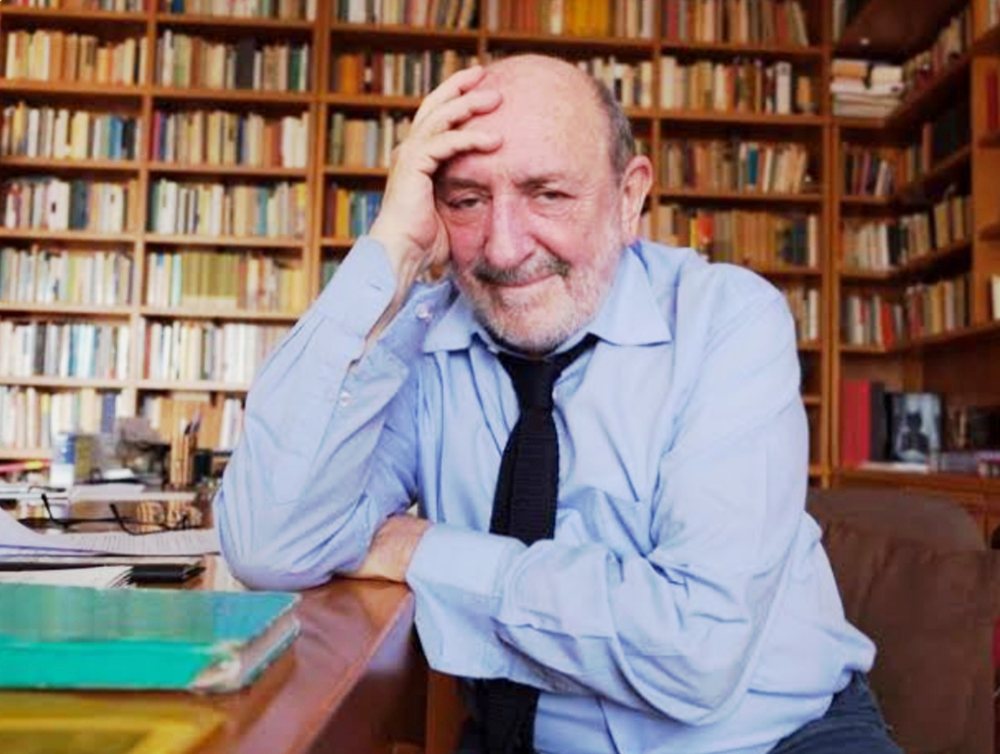
The philosopher Umberto Galimberti is writing a new essay. In his office in his Milan home, filled with books and light, he saves the file on his computer before starting this conversation about secrets. “It’s a book about truth,” he says, “a topic that is needed at this moment.”
Is secrecy the antithesis of truth?
"The first form of secrecy is children's lies. And telling them is important because they represent the first step towards emancipation from parents. When a child lies, it means that he does not want to say something he knows, because he is afraid of the consequences. Thus he makes a choice that leads him to distance himself from his father and mother. It is a physiological transition: having grown up in a relationship of vertical love – the unconditional love of those who brought us into life – we must enter into the horizontal relationship, the conditional one, which regulates friendship and relationships."
In summary, keeping the first secret is a necessary form of emancipation.
"Yes. As we grow older, I think our inner self should be kept a secret. But now, for years, revealing it has become a form of entertainment."
Are you thinking about television?
"Yes, for all those shows – from Maria De Filippi onwards – where the protagonists are asked to expose their intimacy to the public without realizing that by doing so they lose it, because then it is lost. These shows are based on a deception, that of selling it as unrestrained sincerity. The tendency is to think that shame is a matter of the body, but it is not so: showing legs can be good, while baring the soul is much worse."
We should keep it to ourselves.
"Yes, because, I think, the highest form of secrecy is with oneself. Heraclitus said: 'You can never find the boundaries of the soul, no matter how many times you cross its paths; so deep is its logos.' So, we will never know ourselves deeply. This awareness is also essential in marriage."
In what sense?
"Marriage works if I have a concept of the partner as someone other than me and not as my property. I am very sad when I hear people say 'my wife', 'my husband', 'my child': there is nothing that is ours. 'Volo ut sis', I want you to be who you are, is one of the phrases I like from Saint Augustine. If you are going to get married, you must experience the change in your partner as an endless source of curiosity, knowing that you will never reach the bottom of his soul should be a stimulus. Ultimately, it is good for each of us to keep a secret within ourselves, because the truth of difference does not create distance, but a healthy mutual tension. Of course, I am not talking about small secrets and betrayals, but about the interior."
Considering that I won't be talking about the soul, can I ask you a question?
"Of course."
"You taught for years at the Ca' Foscari University of Venice, filling the large hall and students from all faculties coming to listen to you. Today, you travel around Italy giving conferences in theaters and selling out. What is your secret?"
"Think about it, I've always had poor results at school, they sent me a year early and I've struggled a lot. In my second year of high school, I wrote two lines to greet a professor who was retiring and he said to me: 'Umberto, you don't know how to write a single letter in Italian!'"
And then?
"And then, that very year, I withdrew from the seminary and began to study the program of the second and third years of the classical gymnasium on my own. I sat down with my books and only asked for help with trigonometry from a friend of the orator who was finishing mathematics. In the matura exam I got all 8, 9, 10. They published my thesis in the Varese newspaper and I won two study scholarships."
What had happened?
"I realized that if someone teaches me, I don't learn. For me, the only way to learn is to study on my own."
And yet, you have become a great teacher.
"My secret, I can say this, is that I taught for 15 years in high school before going to university. It was very important because in school you have to worry about whether the students understand you. This was also important for analysis: it is not enough to tell the patient what his problem is, he has to reach him and the analyst's task is to guide him on the right path."
So, returning to the high school you had left behind ultimately proved essential.
"Yes, and I am also grateful to the seminary, because it gave me the opportunity to listen to a sermon every day – beautiful, powerful ones, just like they were done in the 17th century – and that's how I learned rhetoric. Even now, in theaters, I occasionally ask the audience if they understood. And if they don't convince me, I repeat it, sometimes even raising my voice. After all, philosophy is diffusion, Socrates liked to soften in the square and ask: "What is justice?" And then start the discussion."
But when did you realize that philosophy was your path?
"The truth is that I wanted to study medicine, but it was too expensive, so I had to switch to philosophy. There's no secret, it was a coincidence."
Umberto as philosopher, psychoanalyst, writer
Umberto Galimberti is an Italian philosopher and author, known for his work in the fields of philosophy and psychology, as well as for his writings on psychology, culture, and social life. He taught at the Ca' Foscari University in Venice, and is one of Italy's most renowned thinkers. Galimberti is the author of several books, including "Psychology and the Science of the Soul", and he is also a critic of modern society and populist culture.
As a philosopher, he has a deep and analytical approach to psychology and society, using philosophy as a tool to better understand human nature and social relationships. He has developed a particular interest in the connection between the individual and society and how these connections shape identity and worldview.
Galimberti is also a renowned speaker and an active contributor to public debates on important social and cultural topics, using philosophy as a tool to understand and help solve contemporary problems.
Source: Corriere della Sera