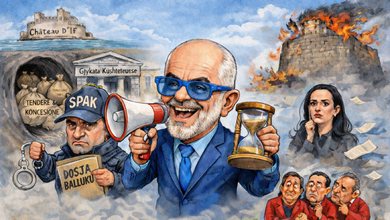




In our Balkan reality, we are accustomed to seeing prison as a kind of well-calculated “business cost.” For an official who has sold his firm, or a businessman who has gobbled up millions through inflated tenders and laundering drug money, spending a few years in a cell seems like a small sacrifice.
This is because, until now, they have had a guarantee: their financial empire would await them intact once they emerged.
But this era of "rich prisoners" must end. The experiment that transformed Romania and that is now knocking on the SPAK offices is sending a message that burns more than the handcuffs: justice has no value if the convict leaves prison as a millionaire.
The financial surgery of the Romanian model
If we want to understand how to defeat structural corruption, we need to look at what the DNA (National Anticorruption Directorate) did in Romania. They weren’t satisfied with arrest statistics. During their golden decade, prosecutors convicted over 1,000 high-ranking officials – from former prime ministers to ministers and mayors.
But the real blow was on legal entities: over 1,050 construction and consulting companies were wiped off the map. Prosecutors applied preventive seizure on every account, every excavator and every asphalt plant, confiscating over 2.3 billion euros.
This was not just punishment; it was dismantling the instrument of crime.
The fall of the “untouchables”: the history of forced bankruptcy
The history of Romanian corruption has names that today serve as legal milestones. The giant Romstrade SA, once called the “Queen of Asphalt,” collapsed overnight when the theft of EU funds came to light; owner Nelu Iordache saw his accounts frozen and the company enter bankruptcy with no chance of rescue.
The same fate befell Euroconstruct Trading 98 and the famous Tel Drum SA, the latter linked to the political dome of the time. These were not just firms, they were monopolies that dictated public life. Today, their machinery is under total seizure, proving that no political shield works when justice strikes an asset and not just a person.
Vertical investigation: from official to subcontractor
A truly functioning justice system must follow the money at every link in the chain. It's not just the official who signs off; it's the contractor who gets the tender and, even more importantly, the subcontractor who hides in the shadows.
There, in the subcontracting segment, the biggest theft often occurs through fictitious invoices and substandard work. SPAK's investigation must be vertical: any entity that has served as a "laundry machine" for drug trafficking money or inflated tenders must be subject to liquidation. There can be no immunity for someone who hides behind complicated chains of contractors, while laundering the proceeds of crime.
Hitting the "root": family and names in the shadows
If we want this process to be painful for the corrupt, we must strike at their legacy. Wealth gained through crime rarely bears the criminal's name; it is hidden in spouses, children, parents, or even trusted drivers.
By Muriel
Extended confiscation should be our new rule. If a construction company owner or a former official owns resorts and villas in the name of third parties and the latter cannot prove the legal source, the state should take them immediately. There is no moral reason for a family to live in luxury on stolen asphalt that takes lives every day.
Towards the "civil death" of corruption
To put an end to the recycling of this system, measures are needed that put dirty players out of the game forever:
• Forced liquidation: The companies involved should be dissolved and their assets sold at public auction to compensate the state.
• 15-year quarantine: Any convicted owner or official should be “banned” from the world of public tenders for at least a decade and a half. This is the only way to prevent the creation of new “masks” and to cleanse the market of parasites.
Albania does not need more spectacles with handcuffs that end in oblivion. It needs a justice system that operates with financial coolness. Only when the machinery of corrupt firms is seized and the accounts of their families are frozen to the core, can we say that we are winning.
Justice is truly served only when the instrument of crime – the stolen property – is destroyed and returned to the public good.