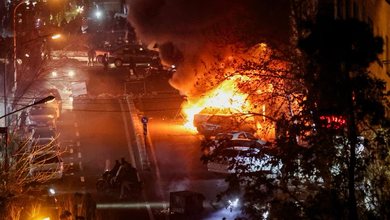
New details about the brutal crackdown on protests in Iran continued to emerge on January 18, with an Iranian judiciary official telling reporters that the "severest Islamic punishments" would follow for those deemed "hostile."
Asghar Jahangir, spokesman for the Iranian judiciary, said at a press conference on January 18 that judges will have free rein in handing out punishments to protesters.
His comments come after a week in which Washington appeared to have backed away from military action against Tehran, following assurances that protesters would not face the death penalty.
Meanwhile, people leaving Iran have continued to tell REL's Radio Farda details about life inside the country.
Relatives of Mohsen Rashid, 42, a protester, said he bled to death after being shot in the leg by security forces. They added that they had been forced to pay thousands of dollars for the release of his body.
In another interview, a pensioner who left Iran on January 17 told REL that "the feeling of a military state of emergency is complete, at night... the armed forces stop cars randomly. They check the entire car and also mobile phones."
Large number of eye injuries
An Iranian ophthalmologist who recently fled the country said that hospitals are struggling to treat all those injured in the protests and that doctors are under immense pressure due to the high number of eye injuries.
"There are reports that security forces have taken injured patients from hospitals," the doctor said.
His testimony follows previous accounts of ophthalmology hospitals being overwhelmed with patients during the largest protests in Iran in recent years. Also, during the “Women, Life, Freedom” protests in 2022–23, REL reported numerous cases of security forces deliberately targeting people’s eyes during the crackdown.
An Iranian citizen who recently traveled to Tajikistan told a correspondent for REL's Tajik service that security forces are still on the streets with "combat weapons" following widespread protests.
Meanwhile, new videos from Iran appear to show government forces and armed civilians attacking citizens sheltering in residential buildings in Tehran. In the footage, which REL has not verified, security forces used a variety of firearms, rubber batons, machetes, batons and lasers.
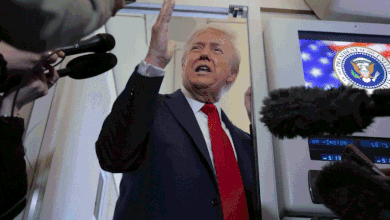
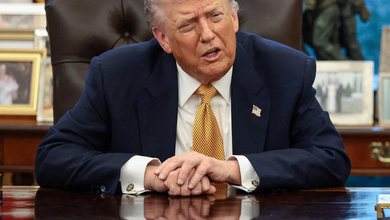
The latest evidence of the crackdown came after an interview in which President Trump said it was "time to look for new leadership in Iran."
Trump also directly attacked Iran's supreme leader, Ayatollah Ali Khamenei, who has represented the real power in the country for the last 37 years and who had previously attacked the US president on social media.
"What he [Khamenei] is guilty of, as the leader of a country, is the complete destruction of the country and the use of violence on levels that have never been seen before," Trump told Politico.
"To keep the country functioning — even if that functioning is at a very low level — the leadership needs to focus on governing its country properly, just like I do with the United States, and not killing people by the thousands to maintain control," he said.
"Leadership is about respect, not fear and death," Trump added.
The most recent challenge to the theocratic government erupted on December 28, 2025, when demonstrators took to the streets over Iran's weak economy, before the protests turned into anti-establishment protests.
The Norway-based Iran Human Rights group has verified at least 3,428 deaths of protesters by security forces, while the US-based HRANA has put the verified death toll at 3,090, including 2,885 protesters, with more than 22,000 arrests.
Human rights groups warn that the real number is likely higher due to an internet blockade in place since January 8, which has severely hampered verification efforts.
Internet restrictions were lifted for a short period on January 17, but monitoring group NetBlocks said the blockade appeared to have been reinstated later in the day.
Trump has taken the lead among Western leaders in attacking Iran's hardline rulers for their brutal crackdown on protesters across the country. The EU, UN and human rights groups have also condemned the Iranian government.
Trump initially warned that the United States was “ready and armed” to act if Iranian security forces killed protesters. He later threatened “very strong action” if Iran hanged protesters, after reports of possible executions of detainees spread.
On January 17, Khamenei repeated his claim that the United States had incited the protests in Iran and blamed the casualties on Trump.
"We hold the US president guilty for the victims, damages and slander he has caused to the Iranian nation," he said in an annual speech marking a religious occasion.
Planned executions of detained protesters
On January 16, Trump publicly thanked Iran's leadership on Truth Social, writing: "I greatly respect the fact that all of the planned hangings, which were to take place yesterday (over 800 of them), have been canceled by the leadership of Iran. Thank you!"
"You had over 800 hangings scheduled yesterday. They didn't hang anyone. They canceled the hangings. That had a huge impact," Trump said in separate statements.
Iran has not publicly confirmed plans to execute 800 protesters, nor has it announced the cancellation of any such planned executions.
Iran's hardliners have controlled all the levers of power in the Islamic republic — led by the supreme ruler and the powerful Guardian Council — since the overthrow of the US-allied Shah in 1979.
Experts say a deep rift is growing between the ruling clerics and Iran's young population, many of whom have long sought greater social and political freedoms in the Middle Eastern country of about 89 million people.
Peyman Jafari, an expert on Iran at The College of William & Mary in Williamsburg, Virginia, was quoted by The Wall Street Journal as saying: “The gap between the population and the state has become insurmountable without major compromises.”
"I can't see how, without major changes, the old guard can survive," he added.
After more than two weeks, nightly street protests appeared to have subsided somewhat on January 17, but reports are impossible to verify after Iranian authorities plunged the country into what witnesses describe as a near-total digital blockade in response to the protests.
Reza Pahlavi, the son of the late Shah of Iran, said on January 16 that he was convinced that the Islamic republic and its regime would collapse in the face of mass protests.
“The Islamic Republic will fall — not if, but when,” he told a news conference in Washington. “I will return to Iran.”
The former crown prince has emerged as a key opposition figure during the unrest, although the Iranian opposition as a whole remains fragmented and disorganized.
External support
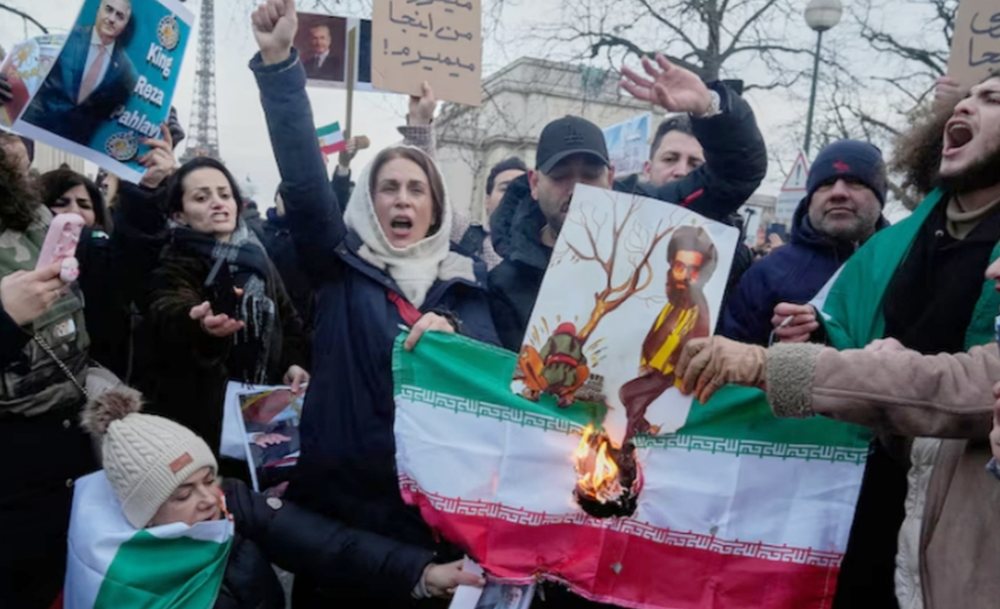
Protesters have received widespread support on the streets and at events in a number of cities in the US and Europe, as well as elsewhere.
Iranian director Jafar Panahi and his daughter Solmaz Panahi at the European Film Awards in Berlin on January 17
Iranian director Jafar Panahi made an urgent appeal at the European Film Awards in Berlin for the world to "react" to government repression.
"If the world does not react to this flagrant violence today, not only Iran, but the entire world is in danger," he said during the opening ceremony.
"Violence, when left unanswered, becomes normalized. And when it becomes normalized, it spreads. It becomes contagious," he said.
Panahi, who has previously faced imprisonment in Iran, has vowed to return to the country to continue his calls for freedom in the country./ REL