For those who lived through the communist regime, the symbolic images that may come to mind are related to the long lines at dawn for milk or kerosene, the crowds of people at bakeries, or the almost empty shops in the late 1980s.
Along with propaganda postulates or the figure of dictator Enver Hoxha himself, these images are being transformed into satirical videos through Artificial Intelligence and are being distributed on the social network Facebook.
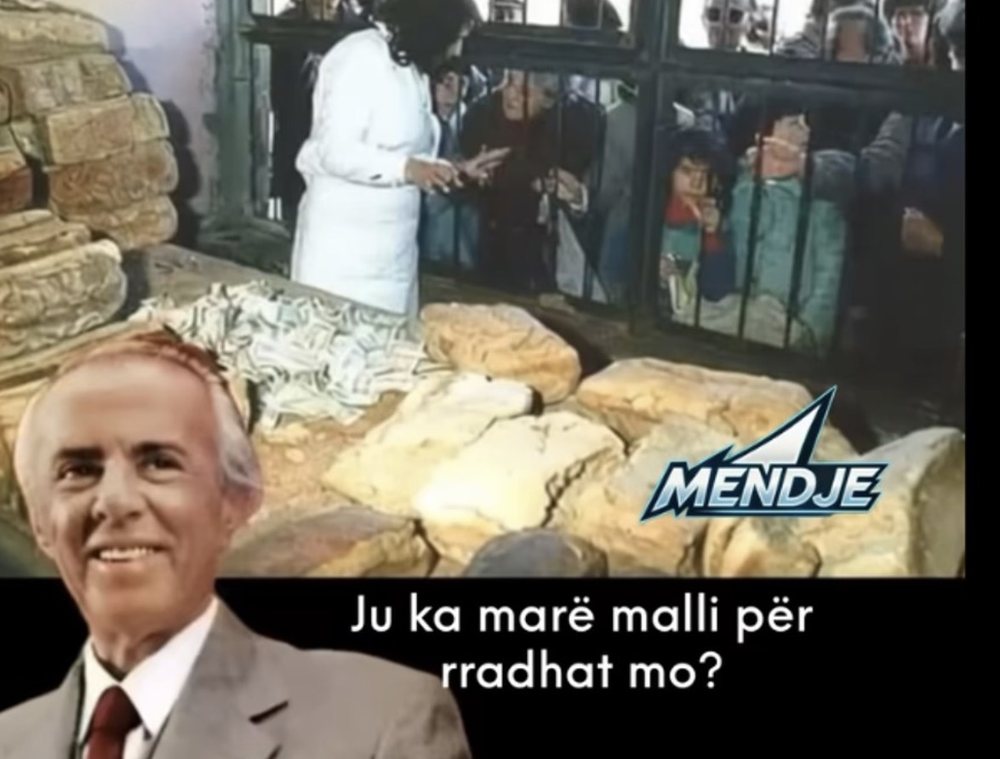
In one of the videos created with Artificial Intelligence, a viral photo of people waiting behind bars to get a loaf of bread starts moving with people greedily touching the loaves and money that the vendor is holding on the counter, while the smiling portrait of the dictator appears with the caption: "Do you miss the lines?"
The video was published on the arts and entertainment website “Mendje” and appears to be intended to satirize past phenomena. However, in the absence of historical context, similar AI-generated images or videos also risk glorifying the communist regime, especially for a society that has not yet fully come to terms with its totalitarian past.
The use of Artificial Intelligence for historical events or figures has raised ethical concerns among historians, who fear misperceptions of historical truths or the glorification of historical figures through the combination of creativity and technology.
“AI-generated images or voices can create a sense of normalization and emotional distancing from the violence, fear and isolation that characterized Enver Hoxha’s totalitarian communist regime in Albania,” Enriketa Papa, a lecturer in the History department at the University of Tirana, told BIRN.
Papa, a descendant of a family persecuted by Hoxha's communist regime, says the use of videos generated by Artificial Intelligence "creates some serious ethical dilemmas for historians."
According to her, this shows how easily new technologies, especially generative AI models, can produce new interpretations and versions of the past. “This often happens without scientific verification and outside of historical contexts,” the Pope stressed.
Most of the models produced by Artificial Intelligence rely on content taken from the internet, a space where nostalgia for dictatorship, old propaganda, and distorted narratives are present.
For Ermal Hasimen, a lecturer in Political Science, it depends on how Artificial Intelligence is used in relation to history and in what context, and the risk increases, especially when it is used to mitigate or normalize the crimes of communism.
“If the image of the dictator is used to show the ideological evil and suffering of communism, then it could be an additional way to raise awareness among young people, but if it is used to relativize communism, for example by showing it as an almost normal system comparable to today, then it would be very problematic,” he argues.
Hasimja sees such satirical videos as an exercise in freedom of expression, but nevertheless appeals that in the absence of an ideological analysis of the regime and the lack of decommunization, the normalization of communism through humor is extremely dangerous.
Hasimja suggests that caution should be exercised if AI is used to glorify communism.
"In this case, this should be treated the same as glorifying Nazism," he says.
The need for legal and ethical rules
"In the case of Enver Hoxha, the use of Artificial Intelligence for visual, audio recreations or imagined conversations can lead to a form of relativization of evil, shifting the focus from crimes and trauma towards a nostalgic and relativizing version of the dictatorship," says Papa, adding that in the digital space there are positivist pages towards the figure of Hoxha.
According to her, the ban on content that glorifies the past and the figure of the dictator can only be regulated by legal provisions and ethical use of AI.
"We cannot stop the development of Artificial Intelligence, but we can and indeed must demand that it be used with honesty, with clear labeling of the content generated and with an interpretative context that preserves historical truth and the dignity of the victims," the Pope added.
On the other hand, the use of Artificial Intelligence in history raises moral and professional dilemmas, as according to the Pope, in the absence of rules and ethics, history risks turning into a show, corrupted, not at all critical of the events or figures of the past.
"Therefore, in order to avoid turning into mechanical-robotic historians, a new regulation and ethics in the use of technology is needed to guarantee transparency, verification and authenticity of historical sources," she concluded./Reporter.al