


By Ergys Mertiri
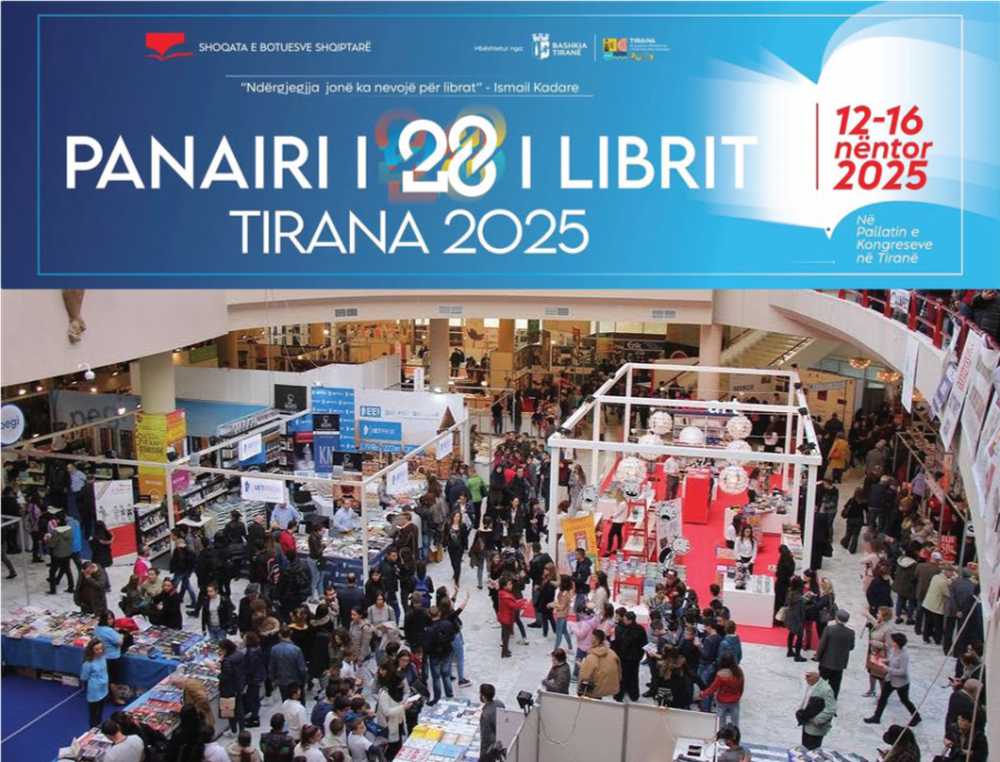
The book fair has some good things. It reminds Albanians that, besides money, sex and power, besides the daily banality that surrounds us, this world also has books. It shows them, especially children, that the world is wider than they think and that there is life beyond the screen. Indeed, real life and experience are accumulated on paper more than on servers.
Likewise, the fair also serves to facilitate our access to good publications, for which, in fact, you will have to dig a lot through the stands overflowing with mediocrity. In any case, valuable publications are also promoted, which find here and there a path to that public that has refined its taste and capacity to appreciate. At least a few days a year, a good part of Albanians somehow distract their attention from the daily Big Brother and remember that in this world there is still literature, philosophy, art, culture.
This would be a miracle, however, if everything were not accompanied by a marathon of television talks in which a series of characters that the screen recognizes as “people of culture” or “publishing” are massively paraded. They fill the screens talking about books with the same amateurism as customers in a cafe discussing the schemes of the national team coach.
The world of books, especially literature, knows an army of stale figures, publishers, association leaders, laudatory critics, officials of cultural ministries or screen writers, who guide strategies and policies for publications, as well as public opinion, towards the corrupt and parasitic vanity of their rotten circles. As in every field, we have here too the shepherds of culture, those who guard the meadow of elitist banality that, more than the values of good literature, aims to prevent valuable products from finding their way to the public, rather than to promote products that are worth it. Characters like these, more than the values of good literature, present on the screens their greatness as tasters and selectors of what should be appreciated.
The vast majority of television discussions about publications that I have encountered these days are no different from those about soap operas or cooking recipes. Suggestions from lemonade, commercial, banal authors, who are appreciated more for the topics they cover than for their ideas, style, or artistic level.
Some time ago, I was amazed to see on TV a well-known personality in the field of publishing who divided and categorized books according to a completely original system of a completely functional nature, in the service of our daily activities. He spoke of weekend books, travel books and even deckchair books, a category of literature suitable for consumption during the summer on the beach. In a way, the personality in question had created a new structure of artistic genres that responds to the needs or circumstantial appetites of the consumer, in complete independence from the values and functions of literature.
The fair also serves, among other things, as a showcase to discover that some characters, whom I doubt are literate, are actually authors of entire volumes of literature. We are perhaps among the peoples who read the least in Europe, but with the largest number of titles per capita, as well as with the highest level of fair attendance. So we are a people that has many writers and few readers, as well as many photographers posing with books in their hands. From this aspect, like many other things, the fair reflects many vanities, as well as the lives and mentalities of the majority of the cultural elite in this country.