


By Doriana Musai
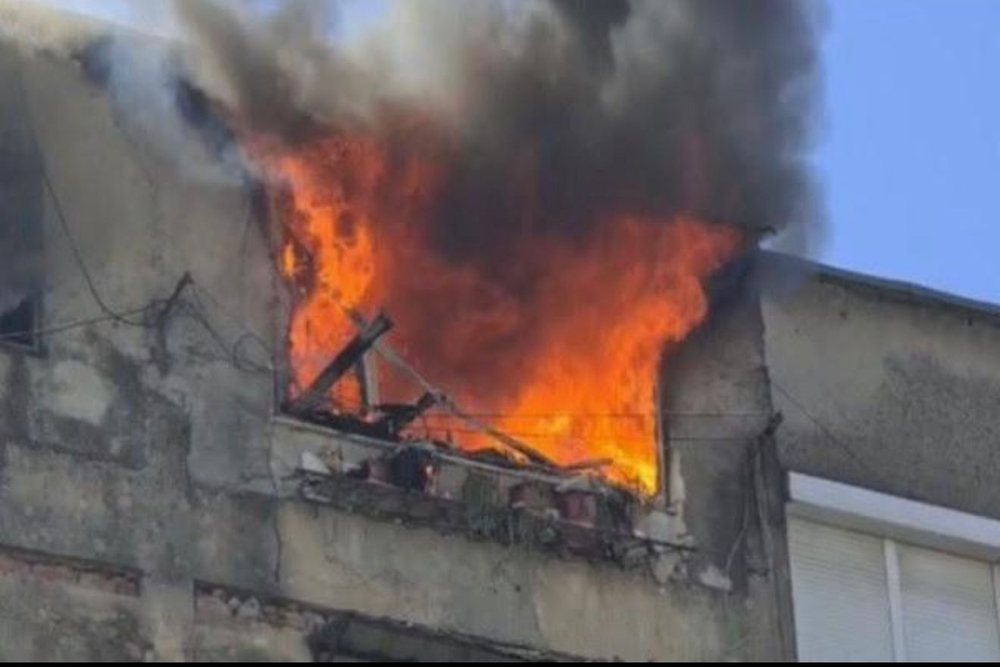
The facades are burning and with them, the illusion of "modern" development.
The facade is not simply a building surface. Legally it is private property, but in practice it is the subject of public decision-making. It is purchased by citizens as part of their property, but it is regulated and controlled by the Municipality. It is enough to see the interventions in the facades of buildings – their painting by the Municipality of Tirana or the placement of advertisements and banners, as well as the permit applied for a minimal intervention such as a shade on the balcony – to understand that the facade is a public instrument and, as such, the subject of public decision-making. And it is precisely this element, treated as the image of the city, that is today emerging as its weakest point.
We have "modernized" the facade of the city, but not the system that is supposed to protect it.
The fires we are seeing in new buildings are not an accident, but the result of a development model where construction technology has advanced, while regulation, control and public infrastructure have lagged behind. For several years, with the law on energy efficiency, the facade has become a separate project and an inseparable part of the building permit file. The “building envelope” is no longer just decoration and aesthetics, but a system that must perform energetically. But this law does not define technical conditions for the behavior of materials in a fire, while the technical framework for fire protection focuses on the interior of the building, evacuation and intervention, without directly addressing the facade as a propagation element.
A paradox has been created for us: thermal insulation is mandatory, while safety remains optional.
The facades that are burning are related to the use of non-fireproof materials, such as polystyrene (EPS), polyurethane or other composite filling and cladding materials of the system. Many of the facades have used these materials as the most economical and efficient solution, but often without considering that they are flammable. However, the problem is not only the material, but the method of use and the lack of mandatory standards. In Albania, these facade systems are applied without a technical protocol and without integrated control. Even when the materials are individually certified, the performance of the entire facade under fire conditions is not tested.
And therein lies the crux: a regulatory gap.
Buildings used to be lower and were built with more fire-resistant materials, such as brick and plaster. Today we have facades with layers and combined materials, while basic safety elements such as fire classification, insulating barriers and restrictions on combustible materials in tall buildings are missing. There is a chain of responsibility – from the designer and the builder, to the supervisor, the inspector and the institutions that issue permits and certification. But everyone operates in a framework that does not oblige them to apply clear standards for facades. This vacuum situation has created an illusion of security: buildings are certified, but not fully verified in terms of fire performance, and as a result, in practice the most economical solutions dominate: the cheapest material, not the safest.
Instead of addressing this gap, the head of government tends to shift the focus towards private insurance of housing in the event of natural disasters, distancing himself from responsibility as part of the decision-making chain for these constructions, through the KKTU. But “natural disasters” are not really “disasters”; they are well-known phenomena of the city. Since antiquity, fires have been part of urban life. The modern state has addressed fire prevention – the consequences of which we rightly call disasters – through public services: firefighters, police, ambulances and emergency response. Governments build the normative framework, subordinate institutions the regulatory one, while municipalities guarantee implementation. This link is weak today and, from public attitudes, it seems that no one has the will to strengthen it.
And we come to the danger of this lack of will.
The risk becomes even more critical in the much-promoted model of vertical development. In buildings over 10 floors, the spread of fire on the facade is faster and more difficult to control. Meanwhile, fire escapes are lower than in the tower-type buildings that are being built (remember: we have over 140 such permits in Tirana alone, approved by the KKTU). So we have a city that builds higher, but does not build safer. On the contrary, safety is being transferred from the obligation of the authority to the public to the individual through private security. So the state is not responsible for what disasters the missing safety measures may cause.
However, the public debate seeks a simple culprit – a material or a builder – as an alibi to avoid real analysis (remember the National Theater’s Populit, to which much was attributed). Because the problem is not a facade or an isolated fire, but an entire infrastructural and institutional system that does not respond to the city being built. For this, responsibility is distributed throughout the chain, not excluding the authorities that grant permits: the Municipality of Tirana and the National Council of Territory and Water (KKTU).
In the end, the issue that is being avoided is this: we have a city that is developing beyond its capacity to defend itself.