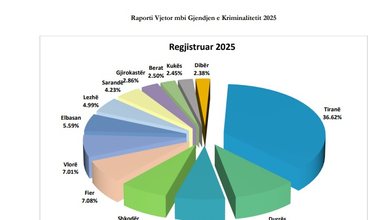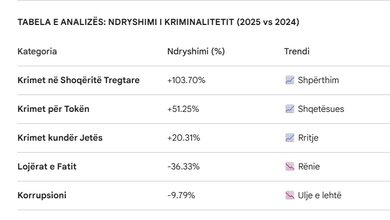




The Annual Crime Situation Report for 2025, by the General Prosecutor's Office, provides a detailed "radiography" of those facing justice. Beyond the total number of 11,587 defendants (an increase of 7.38% compared to 2024), the data reveals worrying trends in education, employment and the social geography of crime.
Crime is becoming "intellectualized"
One of the most interesting findings of the report is the shift in the educational level of defendants. While the number of people with primary education (up to 9 years of age) is steadily declining (from 43.4% in 2023, to 36.08% in 2025), the number of defendants with higher education is increasing.
Secondary Education: Makes up the largest group with 52.41%.
Higher Education: Has increased, reaching 11.51% of defendants in 2025.
Unemployment as a "motor" of crime
The General Prosecutor's Office notes that unemployment remains the main criminogenic factor. Although there is a decrease in the number of unemployed compared to previous years (from 64.9% in 2023, to 47.15% in 2025), the figure still remains alarming.
Private Sector: Almost half of the defendants (49.62%) come from the private sector, a significant increase from 32% in 2022-2023.
State Sector: Remains at low levels, with only 3.23% of defendants.
Are women "gaining ground" in criminality?
Although criminality remains an overwhelmingly male phenomenon (93.95%), a gradual and constant increase in the involvement of women is observed.
In 2023: 5.28% of defendants were women.
In 2024: 5.41%.
In 2025: The figure increased to 6.05%.
City vs. Village
Crime in Albania is confirmed as a predominantly urban phenomenon. The hustle and bustle of city life, anonymity and concentration of the economy mean that 72.60% of defendants reside in cities, while only 27.40% live in rural areas.
The conclusion of "Scanner"
The profile of the typical defendant in Albania for 2025 is: Male, urban resident, with secondary education and unstable economic situation. However, the increase in the number of people with higher education and private sector employees involved in crimes suggests that the nature of criminality is shifting from "survival crime" to organized, economic and "white collar" crime.
Source: Annual Report on the State of Crime 2025, General Prosecutor's Office.