



By Desada Metaj
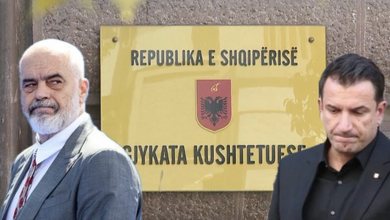
VNA has revealed the arguments on which the Council of Ministers is asking the Constitutional Court to suspend the decision of the Special Court on the "Balluku" case.
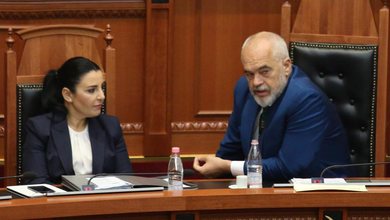
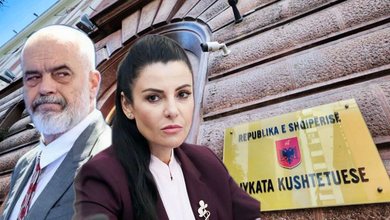
As has been announced, by decision of the Special Court, the Deputy Prime Minister and Minister of Infrastructure and Energy, Belinda Balluku, has been suspended from duty and banned from traveling abroad, as she is accused of abuses with the tender for the construction of the Llogara tunnel and lot 4 of the Grand Ring Road.
The Prime Minister, with the request submitted to the Constitutional Court, has 3 claims. He initially claims that a constitutional conflict has been created between him and the GJKKO which must be resolved by the Constitutional Court. Secondly, he requests the annulment of the GJKKO decision only in the part related to the prohibitive measure “suspension from the exercise of office” for Ms. Balluku. In parallel, he requests that the effects of the GJKKO decision be suspended immediately, until the case is examined on its merits by the Constitutional Court. Thirdly, he also requests the interpretation of Article 103/3 of the Constitution.
The Prime Minister raises several basic arguments for his claims. He says that the decision of the GJKKO has interfered with his powers, since the Prime Minister is the one who proposes the appointment of a minister. He admits that the appointment of the minister is, in fact, partially his competence (because he only proposes, while the appointment is made by the President and the vote of confidence is given by the Assembly) and for this reason he has summoned both the President and the Assembly to judgment.
He raises another argument, according to which, if a minister is suspended from office by court decision, then the activity of the Council of Ministers is hindered, because the absence of the minister paralyzes the entire activity of the relevant ministry and consequently of the Council of Ministers as a whole.
He also raises the argument that the figure of a minister is equated, according to the Constitution, with the figure of a deputy. He accepts that the Code of Criminal Procedure is clear, providing for the suspension of every state functionary, except for those elected according to the electoral law (deputy, mayor and municipal councilor). But, since the deputy enjoys immunity, then — according to the Prime Minister — the minister should also enjoy the same guarantees. And as long as the deputy is not suspended, then the minister should not be suspended from office either. To this end, he seeks an interpretation of point 3 of article 103 of the Constitution.
According to the argument of the Council of Ministers, the Constitutional Court — in application of the organic law and constitutional powers — has the right to order the suspension of the GJKKO decision, as this decision affects high state, social and individual interests.
The request states that the imposition of a temporary measure, until the final decision of the Constitutional Court enters into force, is necessary to protect the system of governance in the Republic of Albania and to preserve the functionality of the executive branch, specifically the Council of Ministers.
According to the reasoning, the highest state and social interest requires that the powers and responsibilities of the Council of Ministers be fully exercised by all its members.
The Council of Ministers warns that leaving the decision of the GJKKO in force — without suspension — would bring irreparable consequences to the governance of the country, creating an institutional vacuum, dysfunction of the Council of Ministers and the inability to exercise the powers that the Constitution and the legislation in force grant exclusively to the executive branch.
The request emphasizes that leaving the decision in force, without suspension, would deepen the conflict of powers between the judiciary and the legislative and executive branches, further violating the principle of separation and balance of powers.
"The Council of Ministers submits that the suspension of a minister or deputy prime minister, in addition to causing the Council of Ministers to malfunction as a collegial body of the executive branch, simultaneously suspends the activity of the executive branch in the area of responsibility of the suspended minister or deputy prime minister," the request states.
It is further argued that the suspension brings serious consequences for the state and social interest, creating an institutional vacuum, as it prevents the proposal of draft acts of national importance for the process of integration into the European Union — around 800 draft acts to be approved by the end of 2027 by the ministry headed by the minister suspended through the decision of the GJKKO.