


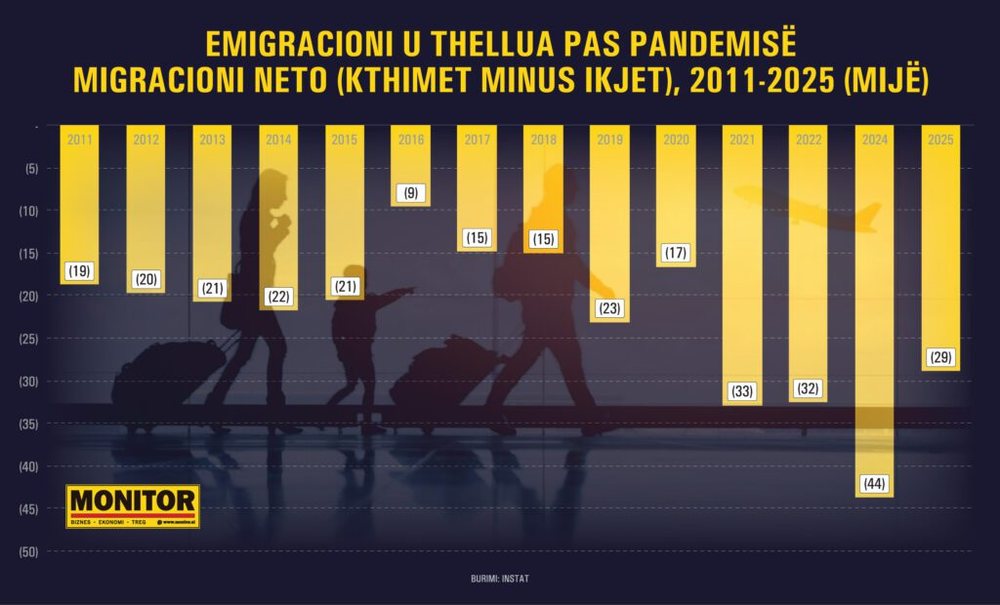
Net migration, the difference between the number of people entering to live and those leaving our country, continues to be negative in Albania throughout the period 2011-2025, showing an increasing trend after the pandemic.
Official INSTAT data show that departures have been stable for more than a decade, but after the Covid-19 pandemic the phenomenon has accelerated significantly, reaching the highest historical levels of the last decade. According to the INSTAT database, from January 1, 2021 to January 1, 2025, Albania had 138 thousand more departures than returns.
In 2011, net migration was around -18,765 people and remained in a similar range until 2015, when it recorded around -20,600 people.
In 2016-2018, a temporary improvement was observed, net migration slowed to -9,473 in 2016 and around -15 thousand in 2017-2018 due to the high wave of returns of asylum seekers who fled to Germany in 2015.
However, after 2019 the trend changed again to a strongly negative one. In 2019, net migration reached -23,082 people, while in 2020 around -16,684 people were registered, a year affected by pandemic restrictions that temporarily curbed international movements.
After the pandemic, emigration increased rapidly. In 2021, the net population loss reached -32,853 people and in 2022 it remained at similar levels, around -32,497 people. The peak was recorded in 2024, when net migration reached around -43,761 people, the highest level recorded also due to corrections from the 2023 census.
In 2025, although decreasing, it remained very high, around -28,836 people.
This trend shows that the pandemic did not stop emigration, but rather pushed it forward and intensified it in the following years. The opening of European labor markets, demand for labor, and better economic expectations abroad have fueled a new wave of departures.
This trend was also confirmed by Eurostat, where for the period 2021-2024, EU member states issued 284,585 residence permits for the first time to Albanian citizens. There is an increasing trend for work permits, which account for almost 1/3 of total residence permits and have doubled compared to before the pandemic.
With this progress, Albania is entering a rapid cycle of emptying. Although the country has fewer and fewer young people, they have been leaving with greater intensity in recent years. These developments are creating a vicious cycle of population decline, increased emigration, and accelerated population decline. The 18–34 age group accounted for about 80% of young Albanian emigrants.
Data shows that the per capita emigration rate has increased, not only in absolute numbers, but also as a percentage of the active population. Albania is in a phase where the youth group is rapidly shrinking and on the other hand those who remain are increasingly motivated to leave.
Today, it is not just unemployed or unpromising young people who are leaving, as was the case a decade ago, but also the best students, young healthcare professionals, IT professionals, and skilled craftsmen, and many family reunions.
High emigration has also created a psychological effect. Young people feel few in an aging and empty society and are more motivated to leave./ Monitor