


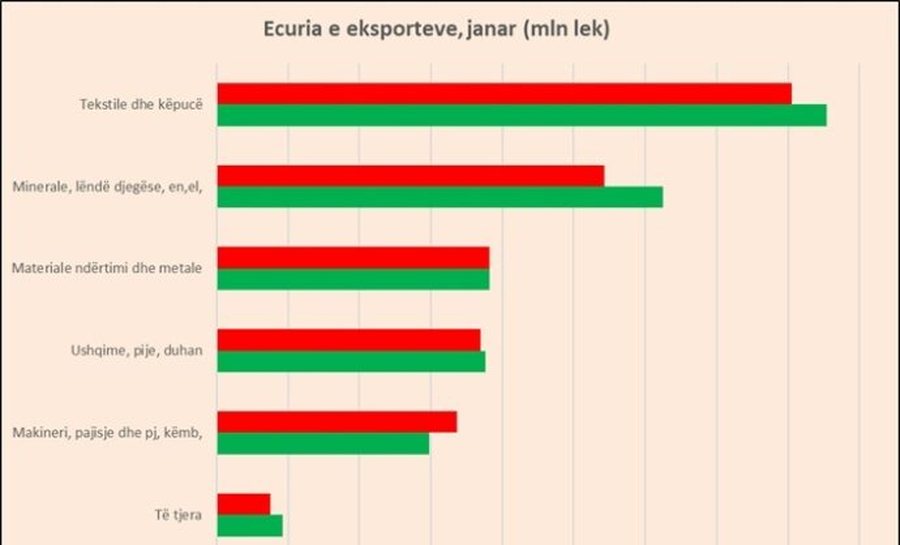
Exports have started the year with a downward trend, shrinking by 4.5% compared to the same period a year ago, according to INSTAT data.
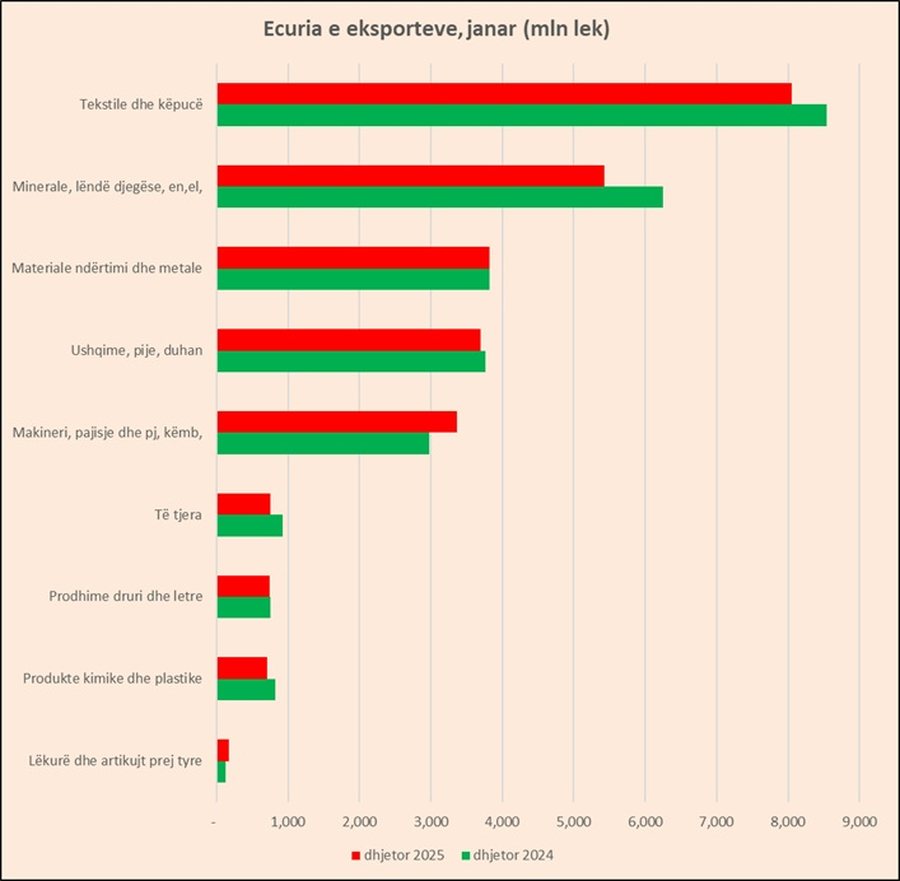
During January 2026, the decrease in exports of 4.5% was negatively affected by the groups: "Minerals, fuels, electricity" with -2.9 percentage points, "Textiles and footwear" with -1.8 percentage points, "Chemical and plastic products" with -0.4 percentage points, etc. The groups that had a positive impact were: "Machinery, equipment and spare parts" with +1.4 percentage points and "Leather and articles thereof" with +0.1 percentage points.
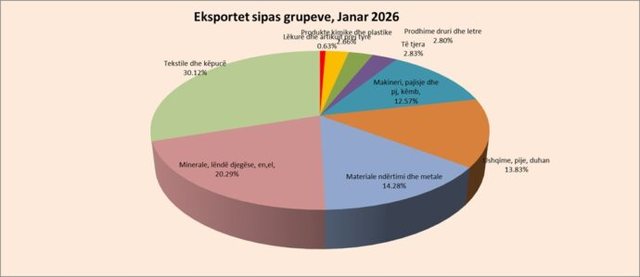
From INSTAT's detailed tables, by sector, the most positive performance was recorded by the commodity group "Machinery, equipment and spare parts", which increased by 13%, offsetting the contraction of other main sectors such as the textile and footwear industry and that of minerals, energy and fuels. Food exports, which have generally had a positive trend, also contracted slightly in January.
Contrary to expectations, garment exports fall by 5.8%, due to the departure of Italian companies
In their forecast for 2026, textile and footwear exporters hoped to recover somewhat after the decline of the last three years. However, January has not started well. This sector sold 8 billion lek in January 2026, a decrease of 5.8% compared to the same period a year ago.
Exports from the clothing and footwear industry started January with a decline as a result of several factors that are negatively affecting the industry this year as well. Florian Zekja from the ProEksport Association said that demand for goods, mainly workwear, has started weakly this year, affected by US tariffs and the contraction of the industry in Germany. Also, the shift of Italian investors to low-cost countries is creating a psychological effect of customers fleeing our country in search of cheaper costs.
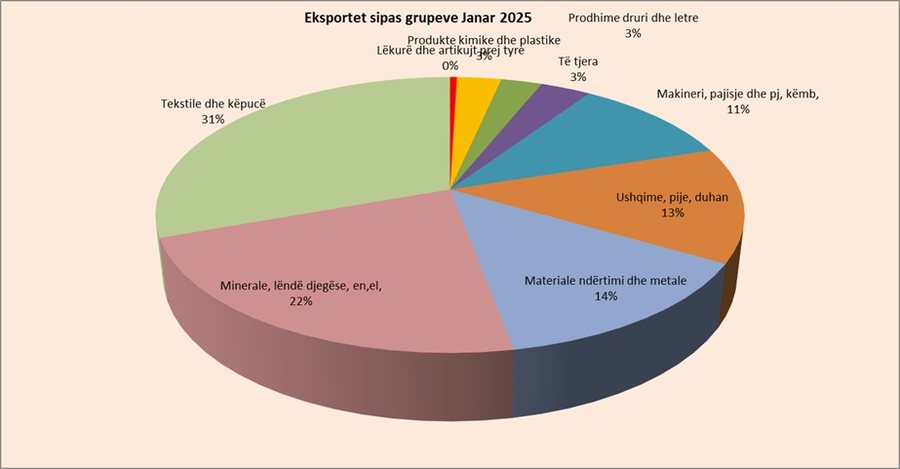
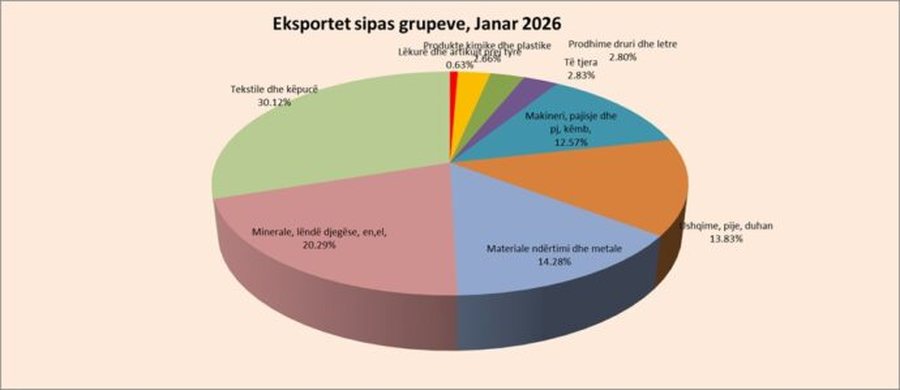
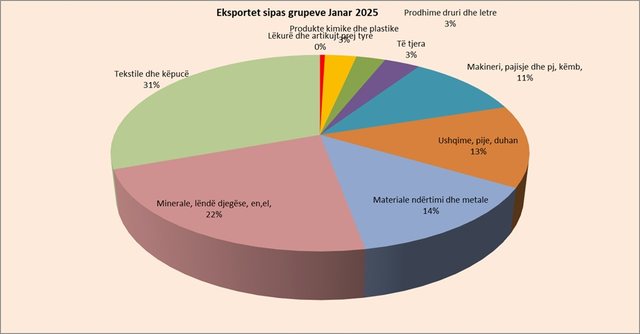
Textile and footwear exports continue to be the largest exporting group in the country with 30% of the total.
Minerals, fuels, energy, with decline
The “Minerals. Fuels, Energy” group exported 5.4 billion lek in January 2026, with a contraction of 13.2% on an annual basis, mainly influenced by the weak activity of one of the largest exporters in the country, “Bankers Petroleum”, which exploits the Patos Marinza oil field under concession. This company, in addition to the unfavorable price situation in international markets, has been in continuous conflicts with the Albanian government over fiscal obligations. According to sources from the company, only one export was made in January.
This group is the second largest in the country, with 20% of the total.
Food, beverages and tobacco affected by floods
"Food, beverages and tobacco", one of the best-performing groups in recent years and one of the two sectors that recorded growth in 2025, has started 2026 negatively. Exports reached 3.7 billion lek in January, with a contraction of almost 2%, on an annual basis. The negative performance of this group was mainly influenced by the floods in January, which affected greenhouse production.
Building materials and metals stop the decline
“Construction materials and metals” closed the year with a 25.4% decline, the deepest of all commodity groups. This contraction was influenced by the closure of Kurum, a steel producer and one of the largest exporters in the country, which is not expected to resume metal processing activity for another two years until the completion of the 150 million euro investment for green steel production in the Metallurgical Industrial Zone in Elbasan, in collaboration with Danieli Officine Meccaniche SpA.
However, in January the decline was halted with exports amounting to 3.8 billion lek, almost at the same level as January 2025. However, sources from Kurum said that the company has not yet resumed exports.
Automotive support industry boosts exports of machinery and equipment
"Machinery, equipment, spare parts" is the group with the strongest growth in January 2026. Its sales reached 3.4 billion lek, with an increase of almost 13%.
This group, where the automotive industry holds the main weight, has recovered since the end of last year when companies reported that orders increased. Some of the companies produce simple parts for work machinery and large transport vehicles, a segment that has been performing steadily. Meanwhile, the EC's decision to leave internal combustion vehicles expected in 2035 in hybrid form changed the panorama for this year as well, where orders are expected to increase. The main pressures that this industry located in our country is going through are related to the workforce, the continuous depreciation of the euro since their contracts are fixed for several years, and thirdly, the sudden increase in the minimum wage to 50 thousand lekë./Monitor.al/