


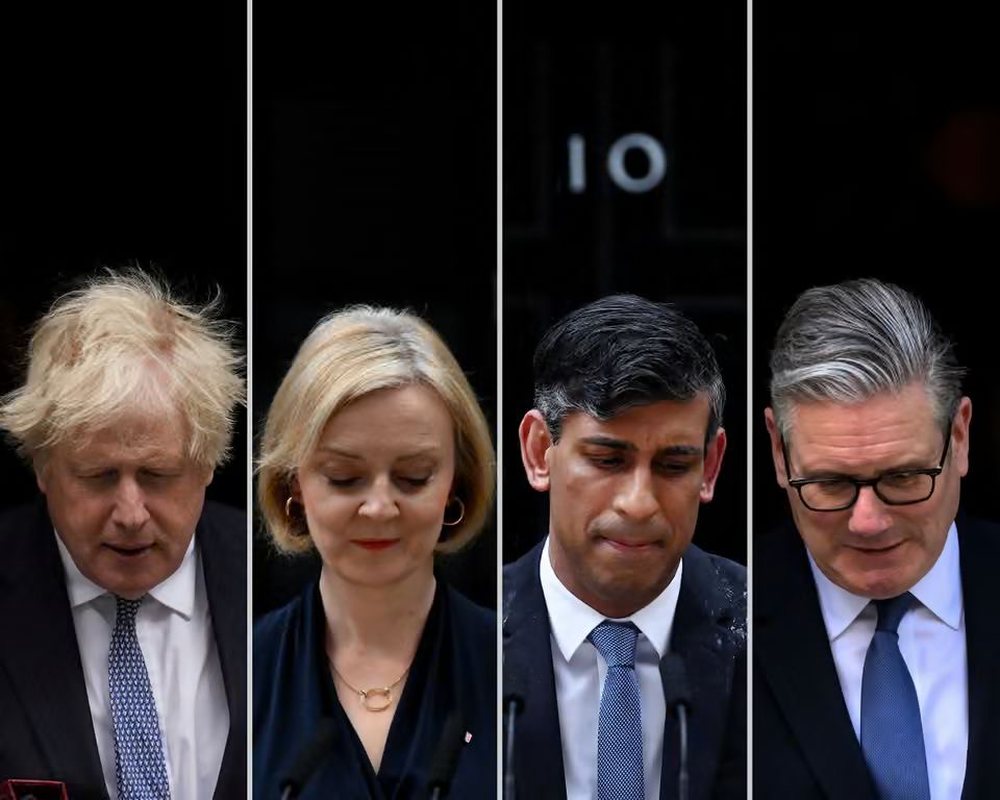
From Theresa May to Boris Johnson, Liz Truss, Rishi Sunak and now perhaps even Keir Starmer, Britain is going through a period of political turmoil that until a few years ago seemed unimaginable for the world's most famous parliamentary democracy.
In his analysis for The Guardian, Tom Clark argues that the problem is no longer just with individual leaders, but with the way British politics works today. According to him, the post of prime minister has become almost "impossible."
The author compares today's Britain to France's Fourth Republic after World War II, a period when governments were repeatedly overthrown, decisions were postponed, and politics was dominated by endless rivalries. Only the arrival of Charles de Gaulle and the creation of a new political order managed to end the French chaos.
Clark writes that Britain is entering a similar crisis. Since the Brexit referendum in 2016, the country has changed six prime ministers and may soon have a seventh. Along with them, ministers, advisers and heads of institutions have been replaced continuously.
According to him, the biggest problem is that no one stays in power long enough to build real reforms. Every new prime minister brings a new cabinet, new priorities, and new people to the administration, while long-term projects remain on hold.
Former British cabinet secretary Gus O'Donnell recalls that at one point Britain had nine pensions ministers in just five years, in a sector that requires decades of strategy. He says that civil service administration finds it almost impossible to build sustainable policies in such conditions.
The article argues that instability stems not only from the personal mistakes of leaders, but from the fragmentation of British society itself. Traditional political divisions have been replaced by much deeper rifts:
Brexit, immigration, culture wars, Gaza, generational differences and social media-fueled polarization.
In this climate, according to the author, it becomes increasingly difficult to create a stable political majority.
For Keir Starmer, Clark writes that he came to power promising to end the chaos, but today he himself is seen as part of it. According to the analysis, Starmer erred by choosing an overly cautious and conservative approach to cultural issues, while failing to build a compelling economic vision that could unite the electorate.
The author warns that Britain risks entering a cycle where politics produces only crisis and short-term survival, while real reforms remain impossible.
However, he argues that the solution is not to give up on politics, but to return to seriousness, patience and long-term projects. According to him, big problems are not solved with slogans, permanent crisis or political spectacle, but with time, stability and real governance.